Showing posts with label Holocaust. Show all posts

Saturday, September 10, 2016

The Second-Class Status of Comics

Having read the first two chapters of Understanding Comics by Scott McCloud, one particular passage from the first chapter stuck out to me. "For much of this century," Scott writes, "the word 'comics' has had such a negative connotation that many of comics' most devoted practitioners have preferred to be known as 'illustrators,' 'commercial artists,' or, at best, 'cartoonists'!" (McCloud 18). It was a sad reminder that, no matter how deep or thoughtful a comic can be, it will always be seen as juvenile by society overall.

Two comics immediately came to mind when I finished that page - Will Eisner's The Plot, and Art Spiegelman's Maus. I read both comics in high school, during a time when I voraciously read through much of Archbishop Spalding's fiction library. Though I had to read Maus for my sophomore English class, I read The Plot on my own time. Nevertheless, I was captivated by the combination of art and prose in both comics.
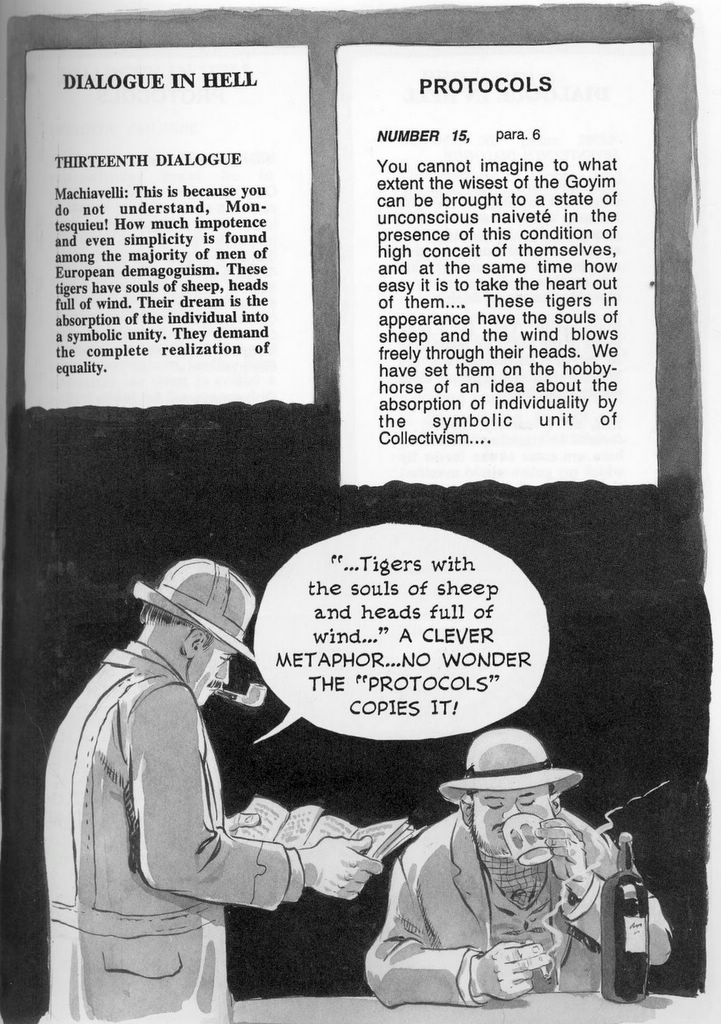

The Plot, a detailed account of the fabrication of the Protocols of the Elders of Zion, had a unique art style that combined detailed character designs with exaggerated expressions. It told a story that spanned centuries and involved disgruntled French authors and conniving Tsarist advisers desperate to hold onto power. It was a well-researched and tragic tale that kept my interest throughout its length. Why, then, is it never brought up in any way, shape, or form when high-quality non-fiction is discussed? Is it the "cartoonish" artwork that prevents critics from taking its contents seriously, no matter how thought-provoking it may be? Or did its black sheep status as a non-fiction comic keep it in obscurity? 

Of course, it is entirely possible to break free from the "ghetto" that most comics reside in, and establish a comic as serious reading material. Maus fits this idea to the T.

I remember my surprise at Maus being taught like the other books in my curriculum. While its subject matter was serious, it looked like any other comic sidelined for not fitting the standards of a "serious book." I enjoyed both volumes of Maus, as tragic as its depiction of the Holocaust was, but a question irked me throughout my reading of it: why this, and not The Plot? Both dealt with anti-antisemitism, historical events, and the depths of human depravity when dealing with "outcast" groups. Didn't both deserve credit for taking serious risks and presenting their material in an unorthodox, easier-to-consume format?

I do not think there is an easy answer to those questions. Sometimes, it might boil down to sheer, dumb luck. Critics in all fields are known for their bizarre tastes - the much-hated and generally-unfunny Ghostbusters reboot currently holds a higher Rotten Tomatoes rating than the moody, thought-provoking "Only God Forgives" and a near-equal rating with the uncompromising "Falling Down." Some practical elements may have factored into this discrepancy: Maus was published nearly three decades ago and had a stagnated release, while The Plot is only 11 years old. 

"What are you driving at, exactly?" You might ask. Well, it all comes down to this - like what McCloud said, anyone defending comics has the deck heavily stacked against them. Though the old-fashioned view of comics being for nerds and children no longer holds water today, it lingers in the backs of society's attitudes. We scoff at comics as being below us, yet we cannot put our fingers on why most people hold that view. 

Granted, for every Batman: The Long Halloween and Watchmen, there are dozens of disposable comics churned out by Marvel, DC, and other companies. But we should never allow our view of a medium to be tainted by its worst examples. Should all of literature be tossed aside because of Twilight and 50 Shades of Grey? Of course not, so why should comics be viewed as an inferior medium due to the existence of garbage like Nightcat?

Comics are undeserving of the second-class status society has lumped upon them. They deserve to be treated like any other piece of literature, not as a minor amusement.

Sources:

Eisner, Will, and Umberto Eco. The Plot: The Secret Story of the Protocols of the Elders of Zion. New York: W.W. Norton, 2005. Print.

McCloud, Scott. Understanding Comics:. New York: HarperPerennial, 1994. 18. Print.

Spiegelman, Art. Maus: A Survivor's Tale. Vol. 2. New York: Pantheon, 1986. Print.


Monday, September 5, 2016

The Origin of Magneto

In most forms of media regarding heroes and villains, origin stories of characters help to provide context and background. For people either watching or reading about the character, the origin story gives a glimpse into the reasons for the mission and actions that a character undertakes. In regards to the former X-Man and member of the Brotherhood of Mutants Magneto, the chilling images from the opening scene of the first X-Men movie reveals the heartbreaking events that created the anti hero. Without this context, the audience could not formulate a complete rendering of Magneto the individual. As a result of his origin story, Magneto becomes a more well-rounded character, enabling individuals to create a sense of understanding for the often misunderstood mutant.
At first glance, Magneto seems to be the one of the main antagonists of the X-Men storyline. However, as the first scene of the 2000 film X-Men shows, Magneto is not only a mutant, but also an individual of Jewish descent, suffering through the events of the Holocaust during the Second World War. This pivotal scene depicts the selection process at Auschwitz and continues to remain as an enduring image to the opening of the X-Men saga. A young Magneto discovers his mutant powers as a result of the traumatic moment involving the separation from his parents (X-Men). Certainly, such an experience would have a lasting effect on the psyche of the young boy, breeding traits of resiliency, self-reliance, and a desire for safety and control within himself.
For the second time in his life, due to his differences, Magneto has been designated as an outsider, someone who is feared, suppressed, and exploited. Sadly, Magneto lost his family in the events of the Holocaust and witnessed firsthand the lengths that humans will go in order to control perceived enemies. As Magneto himself states in the film X-Men, “Mankind has always feared what it doesn’t understand” (X-Men). Having seen the destruction and sorrow which mankind can enforce on minorities without power, one can empathize with Magneto’s approach to defend and protect his mutant family by any means necessary.
This context helps one to comprehend his actions in the movies X-Men and X2 when he attempts to thwart the Mutant Registration Act as well as join the X-Men in defeating Stryker (X-Men, X2). Interestingly, Magneto does not even view himself as the “bad guy” in the story. In X2, Magneto questions, “Is that what they call me?” when told by fellow mutant Pyro that he is referred to as such (X2). Despite the fact that some would consider him to be a monster, Magneto purely does whatever he feels is needed in order to save his mutant family from the fearful humans. Although one does not have to agree with his actions or methods, Magneto’s backstory aids in humanizing his character and establishing an explanation for his ruthless and often uncanny approach to mutant-human relations.

Sources:

X-Men. Dir. Bryan Singer. By David Hayter. 20th Century Fox, 2000. DVD.

X2. Dir. Bryan Singer. By Bryan Singer. 20th Century Fox, 2003. DVD.

I pledge that I have neither given nor received any unauthorized aid on this assignment. Anthony King