Tuesday, December 6, 2016

Try to Coexist?

The main aspects of this comic that really get me going on a rant of questions is simply this…. how could two people doing close to the same thing have so much hate for one another? Everyone has different ways of dealing with life. This is seen between Daredevil and Punisher. No way is certainly right or wrong, but both hate each other for being different from one another.

As I was reading, I thought to myself that their actions against one another, for lack of better words, their actions were stupid. Now, imagine if the two forces teamed up together and fought against crime. I’m not saying that Daredevil and Punisher need to be best friends, they just need to coexist. As Mary writes in a letter to the Punisher, she mentions how the rate of crime has increased significantly since he’s been put into jail. She also mentions lists the forces that stop crimes in the city, which were the police, Daredevil, and the Punisher. With all of these forces being against each other, they are less focused on the defeat of crime but rather in the defeat of one another.


To me, this matter represents a poor allocation of resources around the city. As I said earlier, everyone deals with matters in a different way. I see where the Punisher and Daredevil are coming from, but they both need to learn to coexist. If they were to coexist, crime would decrease and the city would be a safer place. Both of their end goals are the same, to fight crime and to make the city safe. With this said, they are just making their job more difficult than it has to be. 

Picture: http://heroicuniverse.com/the-best-daredevil-vs-punisher-fights/

Monday, December 5, 2016

Can I Get a Back Story??

I think I've officially cracked the code. I've figured out why comics aren't my forte. As most of you probably can guess about me, I don't like being thrown into unknown situations. Sure I can react on my feet and deal with the punches but I prefer to be overly prepared with notes, color-coded binders, a schedule and a time limit. That is ideal for me. But I also recognize that this doesn't happen very often. However....

I absolutely hate it when it happens in books. I hate being thrown into the middle of a story or a plot or a fight scene and I have to work my way backwards, forwards, and sideways to figure out what's going on. You never know a hero/villian's backstory! I'm assuming there are some exceptions to this rule so please tell me them so I can check them out. I want to know if this is what gets me.

I realized this when I was reading the Punisher/Dare Devil comics. Mostly because I wanted to know what happened to the Punisher to make him so evil and twisted. I wanted to know why the heck Dare Devil is a blind ninja man. Was he always blind? Who trained him? WHAT'S HAPPENING?!?

I prefer novels where I create a personal connection with the main character. I like Frankenstein because I was with him as he journeyed thorough his life. I liked Beowulf because I met him at the beginning of his journey. I hated X-men because I get so sick of the classic "you don't know what I've been through" shpeil. Ok, so then tell me what happened to you. Stop being so complex and mysterious, Wolverine, and maybe we can actually get somewhere with this damn story.

I'm really interested in hearing other peoples opinions about this thought because I've started looking at all my favorite books and theres a distinct trend. Mythology is my absolute favorite because you get the story from beginning to end. There's never a point where Zeus is being all pouty because he doesn't want to talk about his past (he's being moody because he inevitably didn't get his way).

I found myself just getting tired of the lack of background I had on the characters.  I just felt like I had a revelation when I said to Punisher (in my head) "Good god man just talk about it and we can all move past this!" But it isn't just with Dare Devil/Punisher. I think many superhero comics are planned this way and I'm sure there is an exact reason for it. I just don't like it. Maybe I'm impatient. Maybe I'm unimaginative. Perhaps I just want some answers. Like I said, this isn't a fool proof theory, there are plenty of exceptions both ways.

Good Deeds, Bad Seeds

Daredevil believes that the Punisher has completely lost his sanity, and with it, his sense of humanity. However, the Punisher still shows some evidence of having human insides - love.

The Punisher was set up by his environment to become who he is.  He is a Vietnam War veteran, and thus learned a kill-them-before-they-kill-you mentality while on search-and-destroy missions.  Although it is not mentioned in Means and Ends, Frank most likely suffered from post-traumatic stress disorder. When his family accidentally stumbles upon a mob execution, they are all shot and killed on the spot - except for him.  He fails to protect his family and is left to bear this burden for the rest of his life.  Frank thinks of his deceased wife, Maria, often, and becomes captivated with a girl named Mary due to her resemblance to Maria--he even initially calls Mary "Maria." With such a horrific past, it is only understandable that he would become a troubled vigilante.  How could we not sympathize with a man that doesn't need to be convicted, but receive help for all of the psychological pain he's endured?

The Punisher continues to protect the innocent and is devastated when he accidentally shoots an innocent bystander.  He yells out in shock with a look of horror on his face and immediately starts running to the man, thinking he may be able to get the man to the hospital and save his life.

"I lost control.  I have crossed the line."

The Punisher also becomes involved with the Bastelli family and protecting Martin from the mob.  The Punisher chases after Martin once he leaves the hospital, finding him at the family apartment.  As predicted, the mob was waiting and the Punisher must fight them off in a shoot-out.  Daredevil arrives, and mid-altercation, the mob has returned, shooting Martin dead and injuring Daredevil.  The Punisher stares at Martin's body, devastated yet again that he has failed to protect the innocent.


Daredevil puts the criminals in jail - but it is evident that this doesn't stop them from managing to communicate with the outside and orchestrate crimes.  In Part IV, Daredevil confronts a woman after visiting her imprisoned husband and unknowingly relaying information for a judge to be assassinated.  Hell's Kitchen is a bottomless pit of criminals, and putting their leaders in jail doesn't prevent them from organizing crimes.  At the end of Part VI, Daredevil reads in the newspaper that the crime rates continue to escalate even after the Punisher is imprisoned.  He then merely looks out the window pensively, as though he wonders if he's done the right thing by taking the Punisher off the streets.


Reference:
Lapham, Dave (w & a), Edgar Delgado (c), Chris Eliopoulos (l), Mike Sellers (l), and Joe Caramagna (l). Warren Simons, ed. Daredevil vs. Punisher: Means and Ends. New York: Marvel, 2006.

Monster Eating...

What a way to end the semester – truly, this war of ideologies exemplifies just how complex the issue of heroism vs monstrousness really is. At no point in this comic is there a moment where I can safely say who is right and who is wrong. So, I won’t do that. What I will say, is that Daredevil is the hero of this story.

I think his role is made clear not only be his willingness to see people as generally good – I feel that sort of optimism is central to the character of a hero these days, and heroes that don’t possess a similar mindset are few and far between – but also where he ends up at the end of this six-part series. That is to say, he continues on his merry way doing Daredevil-things. But what about Frank?

Well, The Punisher ends up in prison – which is extremely fitting. To be frank, pun intended, The Punisher is a monster. A wild animal. And wild animals get put into cages for the safety of others. However, doing good or doing what is right is not solely within the purview of heroes. Monsters like Frank do “good” on a few levels:

First of all, within the context of the comic there’s no denying that “the system” is highly flawed, and Frank helps remedy that issue by working outside of the system. He serves to cross the line other heroes are not willing to cross in order to get the job done, and permanently removes threats to society from its confines – the only thing protecting them from punishment is plot-armor. Here’s an analogy: Biologically speaking, a “good” cell is programmed to kill itself if it ever becomes unviable for the good of the macro-organism. Cancerous cells, however, typically lack this property, and continue to wreak havoc and propagate until they’re dealt with or the body can no longer function. Additionally, the body doesn’t always recognize them as threats. So, like a really good white blood cell, Frank hunts these cancers down and ends them in an effort to remove the cause of the degradation of his society. Unfortunately, that kind of behavior is regarded as more or less intolerable by society – the sliding gray-scale of society also makes it impractical – and Frank’s an unstable person that makes mistakes.  

Additionally, and let me jump back to number five of those seven theses from Monster Culture for this one, The Punisher and characters like him serve as a call-to-arms for the heroes of their stories. They unveil the ugliness of their settings, and challenge the righteous to step up their game, lest their more merciful methods be left by the wayside.

In short, Frank’s a monster that eats monsters. He’s not acceptable by society’s standards – and wouldn’t the world be bleak if he was – and he’s not really a hero, regardless of the good he sometimes does. However, he does keep the line between the common folk and the other monsters in check, and offers heroes a look at just how bad it can really get…


Y’know, I think Nietzsche had a quote about hunting monsters.

Resources:


Cohen, Jeffrey Jerome. "Monster Culture: Seven Theses." From Monster Theory: Reading Culture.
Minneapolis: University of Minnesota Press, 1996. 3-25.

Lapham, David. Daredevil VS Punisher: Means and Ends. Marvel Comics.

A Righteous Kill?

One of the more complex characters of the Marvel Universe is the Punisher (Frank Castle). Although he attempts to bring peace to Hell's Kitchen, his methods are somewhat unorthodox in comparison to other superheroes. For example, he has no moral quarrel with killing people as long as they are deserving of such a fate in his mindset. A former soldier, the Punisher's unique approach to instilling justice is the polar opposite of his counterpart, Daredevil, who prefers to let the legal system judge the individual's innocence. Daredevil's moral code prevents him from killing. As the Punisher states, "I'm not like him. I'm a soldier. Trained to kill" (Lapham, 17). The actions of the Punisher within the comic leads one to question his/her own morality as to what is correct in a situation of vigilante justice. Are there limitations in the pursuit of justice? Is there such a concept as a righteous kill? Personally, I do believe that in certain instances killing is permissible. However, the constant path of killing appears to have taken its toll on the Punisher, forcing him to view death as the only option in the end.

So far, the Punisher has been lucky with the victims that he chooses to terminate. Most people would agree that the individuals within his sights lacked innocence and escaped justice for too long. However, when he accidentally shoots a bystander during his altercation with Daredevil, the Punisher feels remorse for the individual because of his perceived innocence (Lapham, 20). Like Daredevil, the Punisher possesses a moral compass himself, directing his actions. He would call this moral barrier "the line" (Lapham, 20). To the Punisher, he has already determined his target's guilt and views the finality of death as the only punishment he/she deserves. The problem with the Punisher's ideology is that no one is fully innocent. Therefore, anyone could be his next target. In fact, by completing the killing, one could make the argument that the Punisher is no saint either because of the path of vengeance he undertakes as a result of his family's murder. His method is a final solution to a problem that never ceases to exist.

But is the Punisher justified in his actions? Since his victims are involved in heavy criminal activity, most people can push aside his deeds since that means there is one less criminal on the streets of Hell's Kitchen. Daredevil's methods work for a short period, but eventually, the criminals he puts behind bars find their way back to the same activity they pursued before their arrest. The Punisher believes that he is on a righteous cause. However, at this point, I consider him beyond the point of saving, revealing no strain of humanity within his being.

https://i0.wp.com/fusion.net/wp-content/uploads/2016/03/daredevil_titulka_53.jpg?resize=1600%2C900&quality=80&strip=all


I pledge that I have neither given nor received any unauthorized aid on this assignment. Anthony King

Sources:

Lapham, David. "Daredevil Vs. Punisher (2005) #4." Marvel.com. Marvel Comics,13 Nov. 2007.

             Web. 27 Nov. 2016.

Sunday, December 4, 2016

Are People Inherently Good?

Although I was confused at the start of this comic, after clearing things up a little in class, I was able to come back and read the rest of it in a new light. And I have to say, it was pretty cool. I even liked the dual narration by the end of it; the juxtaposition of Daredevil's and Punisher's mindsets showed me which character I empathized with more. And honestly, that was the weirdest thing about this comic for me... I really found myself agreeing with the Punisher more than Daredevil.

Needless to say, we are inclined to think that morally, it is not right to kill another person. Even though that is how the Punisher decided to fight crime, I think that his arguments were much more realistic and practical than Daredevil’s. Sure, in a perfect world, Daredevil’s ideas could come to light. If you just rough someone up a bit, make sure they suffer a little for what they did, maybe they will realize the error of their ways and decide to change. However, that’s honestly not at all the way people work. 


It’s really hard for people to change; they have to really want to. You can’t force someone to change the way they think and the way they live their lives. It’s nice to think that people are inherently good… but are they? In the comic, I feel like this question is highlighted a lot… and the answer is arguably not on Daredevil’s side. For instance, a lot of the plots that Jackal and his henchmen formulated could not have gone on without the paid help of others. Save for the woman visiting her husband in jail who clearly did not know she was part of any plot – a lot of these regular “inherently good” citizens were willing to tell lies for money. I’m sure they didn’t think of the implications of their lies… but still. Is lying for money an inherently good thing…? I would think not.

Additionally, the Punisher was the only one getting any results. At the end of the comic, we hear from Mary’s letter that crime had skyrocketed after the Punisher was put in jail. Obviously, crime goes down if there are less criminals around… However, I think that it’s possible some criminals “came out of hiding” once they heard the Punisher was in jail. Sure, that’s a lot of speculation… but if I were a criminal and knew there was a random guy around that would not just put me in jail, but kill me at any moment, I might decide not to commit a crime. Take away that extra fear and of course, crime would increase.


I don’t know… I mean, I’m honestly still not 100% convinced and on Punisher’s side. But really… is punching a murderer in the eye and throwing him in jail going to make him change? I really don’t think so. I mean, look at the Punisher. At the end of the comic, he had been beaten up by Daredevil and put in jail. I don’t know about you guys, but I don’t take him saying that “this time, there will be no compromises. No mercy. This time, I’ll get it right” (page 148) to mean he’s learned anything.

Thursday, December 1, 2016

Punisher vs. Punisher

Daredevil vs. Punisher: Means and Ends is basically a story about Punisher fighting himself. He is struggling with his demons and tries to fix himself through what he calls justice. During the first three issues, we experience Punisher struggle to maintain his control. He had to keep reminding himself to stay focus and forget about all the stuff that might jeopardize the mission. When he meets Mary, he can no longer stay focus. Once he sees Mary’s face he can no longer suppress the memories.
Of course what he is doing is not ethical. Killing people, even if they are scum, is still bad. Last class we discussed how Rick from The Walking Dead went from “You kill? You die” to “You kill--you live.” He did it out of necessity, he needed to commit those horrible acts in order to survive. In Bishop’s article there is a quote from Rick to Carl “I do things… a lot of bad things, to help you, to help you and all the other people in our group… That’s the world we live in now… but Carl, you need to never forget… when we do this things and we’re good people… they’re still bad things… You can never lose sight of that. If these things start becoming easy that’s when it’s all over. That’s when we become bad people.” (Bishop 83). There is no doubt that Rick is a good guy, we sympathize with him and we understand why he is doing it. We may even admire his courage and his dedication to his family.
Punisher on the other hand, he is a bit hard to sympathize with because he is not doing it out of survival. I don’t even think he is doing it just to protect the city and bring justice. He has selfish reasons. He is trying to fill the gap his family left. He is trying to bring justice for his own family.
Punisher is trying to release the pain and anger in him. He may not want to admit it, but he enjoys the killing. I think it scares him how much he likes it. It feels good to kill the bad guys. Does that make him a bad person? No it does not. It is very easy for him to kill them because he has a reason. Those criminals have lost all humanity according to Punisher. He is not going around killing people, he is killing monsters. He is killing people who deserve to be killed. He is in control about who he kills. If he loses control, tragedy will strike like it did here:
He starts firing… he is trying to control it… and then…
He lost it. Look at his face. Imagine all that pain being released from his body. Imagine how he must feel after all this time suppressing everything. Imagine how good it feels to pull that trigger and let those bullets flow. Imagine how it feels to lose control. But of course, that comes with a price.
Now look at his face. Look at his pain. He knows why he has been hiding this side. He knows why he cannot let go. Imagine how horrible it feels to pull that trigger and let a bullet hit an innocent man. Punisher did not enjoy that and it was not easy for him. He hated himself for shooting an innocent man. He sees himself becoming the type of person he hates. That is why he is not a bad guy. He is just a man who does bad things. Punisher is complex. He is not a bad guy, but I cannot say that he is a good guy. All I can say is that I sympathize with him, but I know that he will not be able to control himself forever. Eventually and unfortunately, he will be a bad guy. He will never be satisfied and he may not care about who he kills.

Sources:
Bishop, Kyle W. “Battling Monsters and Becoming Monstrous: Human Devolution in The Walking Dead." Ed. Marina Levina and Diem-My T. Bui. Monster Culture in the 21st Century: A Reader. New York: Bloomsbury Academic, an Imprint of Bloomsbury Plc, 2013. 73-85. Print.

Tuesday, November 29, 2016

Shambling Around the Ivory Tower

Monster Culture in the 21st Century truly is the gift that keeps on giving. A collection of 20 or so essays by various academic sources, the book consistently demonstrates the same approach to analyzing the world through popular culture - present arguments under a guise of concern for disenfranchised peoples while attempting to mask the smug contempt most of the contributors hold towards them. Often, the true feelings the authors hold bleed through into their essays, forcing the reader to question how genuine their arguments truly are.


In his essay for chapter 14, Michael S. Drake seemingly defends the poor and impoverished against what he considers typecasting by zombie fiction authors. Drawing back to older zombie movies and Haitian voodoo beliefs, he criticizes various facets of zombie fiction as power fantasies where the wealthy and privileged can wreak havoc on the lower classes without remorse. However, the comparisons he draws and language he uses suggests a complete disconnect with the working class. He directly compares recipients of welfare and the proletariat to mindless, shambling, flesh-eating zombies. He implies that they would not be aware of this without academics such as himself explaining the concept in great detail. Furthermore, he shows contempt for the upper classes by portraying them as violent brutes who would happily indulge in horrible acts of violence if there were no consequences for their actions. 

His attitude is that of superiority and disdain for anyone outside of his inner circle, which is shared by several other authors in the book. Mary and Carmen Lugo misconstrue the plot of Lakeview Terrace to reinforce their argument in chapter 15, showing either an indifference towards the audience or a lack of integrity on their end. The contributors of Monster Culture seem to, for the most part, thumb their noses and sneer at their own "Others," whether they be blue collar rural Americans or people with higher salaries than they have.

The entire affair reminded me of the Hamilton Boycott and backlash. On both ends, the controversy about the musical was silly, but the responses to the calls for a boycott were anything but. Celebrities and left-leaning figureheads mocked those who supported the boycott, making fun of their lower social standing, education, or inability to purchase tickets. The same people who claimed to stand for the working class in the election demonized those within that very class for not sharing their views.


This sense of superiority isolates people like Drake from the issues everyday people face. In their eyes, their "Other" is just too ignorant to help, and should be subjected to humiliation and shaming tactics. A similar issue plagued some mainstream news outlets during the election. Academics need to be willing to leave their ivory towers and try to understand ordinary people - even those who might not be near them on the political spectrum, or *gasp* did not vote for Hillary Clinton. Political tensions are high enough, so it might be time to drop the narcissism and the buzzwords for some respectful discussions.

Of course, people like Drake could go on living in echo chambers and getting their opinions bounced back to them by their colleagues. It's not like ignoring a changing political climate has ever backfired for people like him before, right?


WORKS CITED:

Levina, Marina, and Diem-My T. Bui. Monster Culture in the 21st Century: A Reader. New York: Bloomsbury Academic, an Imprint of Bloomsbury Plc, 2013. Print.

Monday, November 28, 2016

Metaphorical Zombies

First of all, my apologies, but I am very, very tired. 

The idea of the zombie as a representative of our national consciousness and ideology is an interesting one, but - to get this out right off the bat - I do wish that Drake would explain Beck's concept of the "second modernity" clearly and plainly. What, exactly, is that and what does it mean? Is it like the new tech boom, or a second industrial revolution? If he explained it further in the essay I couldn't find it, and because it's the crux of his argument, I think it bears some increased scrutiny and attention. Trying to read this article with "second modernity" in mind without knowing what it meant was frustrating. I don't... disagree with Drake, at least I don't think I do, but I felt slightly unprepared having not read Beck's essay to compare with Drake's. But maybe that's just me, and maybe I missed the "second modernity" (which sounds more and more like the second coming the more I think about it) or misread. Hey, it's late. 

Something that Drake does point out, and clearly explain, is the origin of the zombie in Haitian Vodou. He quotes David Inglis, who points out that "the Haitian fear is not of zombis... the fear is instead of becoming a zombie" (Drake 231). The zombie represents the enslaved condition of Haitians and of other West Indian countries/former colonies, a condition that they have a horror of returning to. This history of the zombie isn't entirely unfamiliar to me - an interesting way to experiment with Drake's ideas is with the text Wide Sargasso Sea by Jean Rhys. A postcolonial prequel (I know, I know) to Jane Eyre, it explores the life of Mr. Rochester's first wife, Antoinette (Cosway) Mason, in Jamaica, before she became the "madwoman in the attic." 

SPOILERS BELOW: 

After her marriage, Antoinette's husband renames her "Bertha" in an attempt to distance her from her mother's madness, which Antoinette/Bertha ultimately inherits despite his efforts. Over time, Antoinette/Bertha becomes increasingly paranoid that Rochester is trying to turn her into a "zombie" by taking her name - if he takes her name he controls her. If I remember correctly, this renaming is obeah, a term used to refer to West Indian folk beliefs, witchcraft, and sorcery. It's black magic, obviously not good. The point I'm ultimately trying to make is that the zombie does not necessarily need to represent national consciousness or national ideology, even though, in Wide Sargasso Sea, I think it does - in addition to several other metaphorical meanings. Zombies represent those stripped of power, the victims of institutional oppression. At their core, like everything else it seems, zombies are about power. I think a quote from Harry Potter is a nice closer/philosophical snack to munch on: "there is no good and evil, there is only power, and those too weak to seek it." 

The Monster Within

I am rapidly running out of things to talk about in our blogs, so I am going to venture into new territory with today's post.  In high school, I taught a course on how to survive the zombie apocalypse (I am being completely serious) in which I demonstrated the do's and don'ts of surviving when the dead rise from their graves.  Another part of the class was examining how "zombie culture" affects the world today, and the different ways in which the concept of the living dead could be applied to not only the literal sense of the term, but also how people conduct their lives on a daily basis.  The mission was to show that the living dead are not only found in the form of brain-eating zombies, but in everyday life.  For example, in one of the older zombie movies from the 1970s (I believe it was Dawn of the Dead but I may be wrong) the main characters enter a shopping mall infested with zombies.  As they observe the brainless automatons shuffle about through the stores, the main characters comment about why the zombies chose the mall to reside in.  One character suggests that the environment was familiar; that the zombies, when they were human, went there every week in life and thus returned in death.  There was a lot of symbolism in that scene, much of which I have forgotten, but I remember one key thought I had at the time: what defines the living dead?

I suppose I was trying to link the concept of the living dead who aimlessly wander around shopping malls to society today.  As I watch people fight over the best holiday deals (such as that Nike store in Washington that got trashed) I often wonder if the living dead already exist within us, in our innate nature to put self above others or aimlessly wander around shopping malls.  Sure, we're not yet reduced to eating each other's brains like real zombies, but if the fear irradiated by the concept of the zombie is the loss of consciousness to animalistic nature, what separates the characters in The Walking Dead, who are trying only to survive (and end up harming each other in the process) from the zombies?  In order to separate ourselves from the zombies, it would be wise for individuals to focus on what makes us human in times of crisis, such as helping others in need or being creative.   Yet, it always boils down to people just trying to survive another day in the zombie-world, which brings up the question: if the zombies rise from the grave, will it not drag down society's humanity with it?

Attack of the Social Media Zombies

Although I do not find gore-filled depictions of zombie apocalypses particularly scary, the idea of turning into just another member of a zombie horde is unsettling. Being human involves being an individual and having some sort of agency over our own decisions. A zombie, on the other hand, merely obeys its base instinctual drive to consume and spread. Even a small scratch from an infected host could lead to your undying allegiance to the undead horde, and the odds of surviving a zombie apocalypse decrease as the size of plague grows. The only hope you have left is for time to take its toll on the rotting carcasses and decay their flesh from the bone.

http://i.imgur.com/ms6iWay.jpg
The tragic reality of living in a zombie infested world is that you must become like the zombies themselves in order to survive. In The Walking Dead, the lead protagonist, Rick, learns this through his struggle to keep his family and himself alive. Rick learns the dangers of interacting with both the living and the un-living, rationalizing his problematic decisions with the axiom, “you kill, you die”. As Rick begins to fully comprehend the state of his world, his view changes to “you kill, you live”. Rick is becoming a zombie himself, not through infection, but by aligning his core motives with that of the undead. His zombification will be complete when he begins to believe ‘you live to kill’. At that point, there is no turning back.

http://media.caglecartoons.com/media/cartoons/136/2016/07/11/181927_600.jpg


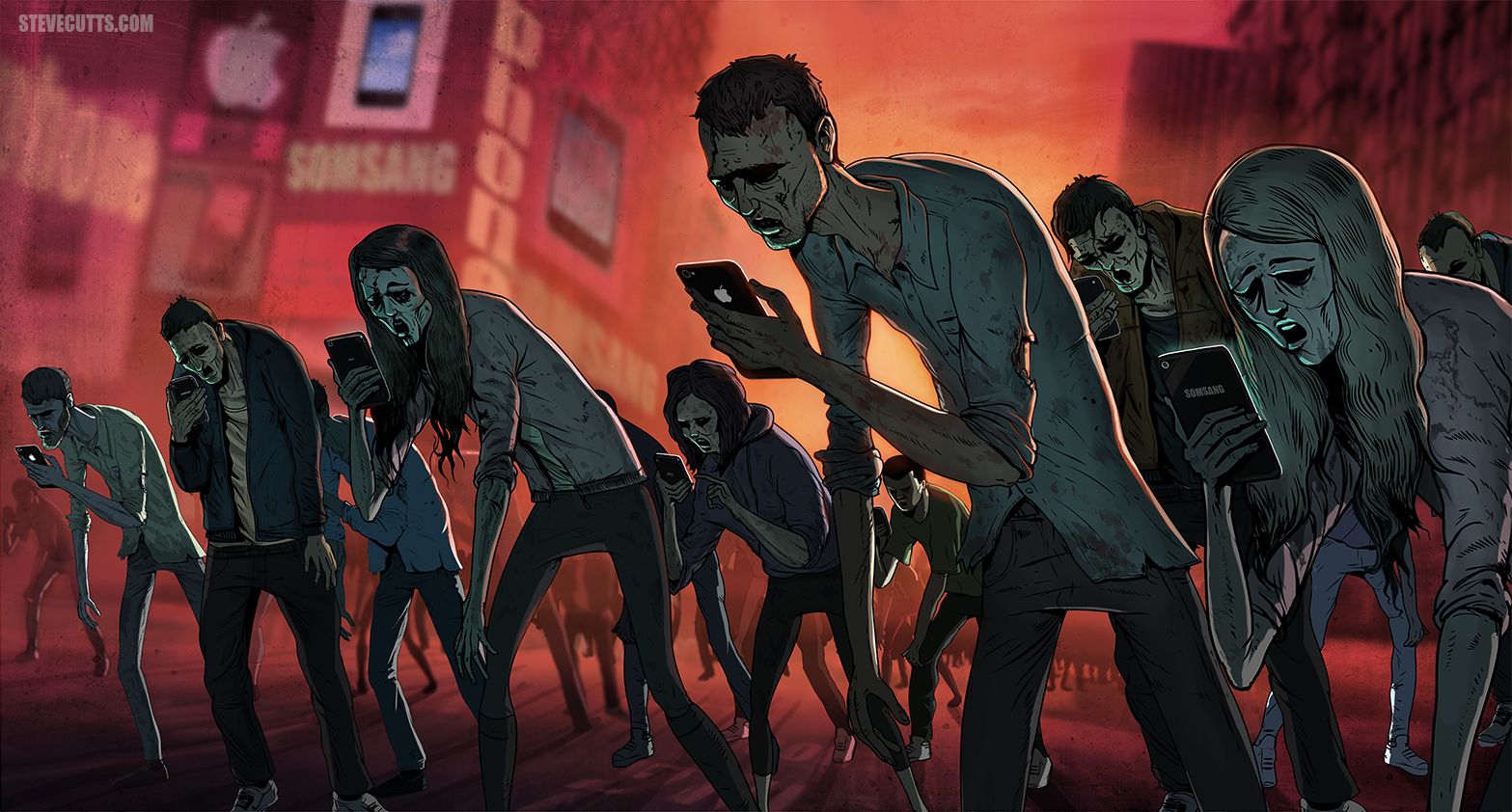
The parallels between zombie plagues and modern consumer culture are what I find truly terrifying. Commercial and ads are now constantly hiding away in our pockets. Aside from phones turning people into real world equivalents of zombies (ex. Pokemon Go zombie outbreak of 2016), phones provide a way of reinforcing mob behavior. Technology has allowed us to condense everything into a small package to be easily consumed through social media, and this ease of consumption is what makes social media addictive. Social media is built around virulent behavior through its use of likes, shares and retweets. A good example of virulent mob behavior produced by social media are ‘challenge videos’. This viral sensation causes the host to upload a video of themselves preforming a ‘challenge’, ranging from pouring ice water on their head to eating spoon-fulls of cinnamon for no apparent reason other than being part of the collective. The social media zombie functions similarly to the fiction zombie, obeying its base instinctual drive to consume and spread, but, in this case, consume and spread kitten videos, 'dank memes', and BuzzFeed articles.

http://www.zerotoalpha.com/wp-content/uploads/2016/09/social_media_zombies.jpg
I believe our own society is reaching a point of no return, where our social media zombification will be complete. We are transitioning from ‘you consume, you live’ to ‘you live to consume’. Living without participating in social media is becoming more difficult. In order to survive in modern society, one must become a social media zombie. So share those hashtags, click on some ads, enjoy those ‘dank memes’, and join the rest of horde.

Sunday, November 27, 2016

"Good Zombie Movies Show Us How Messed Up We Are"

Honestly and truly this class is the reason I became hooked to The Walking Dead. I definitely think that the comic is better than the show but the show keeps me watching just on the sole fact that I want to see what happens in the end. What are Rick and his whole group really fighting for? To survive, definitely, but we are at a point in human civilization that life isn't all about surviving anymore. I personally think that going backwards in how we live our lives is a life that isn't worth living.


Monster Culture really shed light on my thoughts about The Walking Dead and zombies in general. Zombies don't really seem to be the scariest part of the show or any show having to do with zombies but rather how monstrous the humans become in trying to survive. Throughout the show it becomes easier and easier for Rick to kill humans in his efforts to protect the group but you can see that as he continues to make excuses for why killing someone was okay, he starts to lose his humanity. I agree with the fact that zombies represent our fears and doubts. Although it may not be killing someone, our fears and doubts make us do crazy or unhealthy things. Even something as simple our fear of not doing well on an exam will force us to stay up all night or drink two or three energy drinks despite the fact that both aren't good for your health.

In any zombie situation, humans are the true monsters because we "become chaotic creatures if selfishness, violence, and unchecked aggression." But one of the quotes that really stood out to me was, "Whoever battles with monsters had better see that it does not turn him into a monster." this quote reminds me of Star Wars in that those who continue to give in to the dark side becomes apart of the dark side. The fear of being bitten by a zombie but also the fear of losing your family would definitely drive any human to be monstrous because in reality we are selfish.

One of the things that I didn't understand the most about The Walking Dead was how many humans were killing each other. I thought that every time a human group would encounter another they would join forces and work together to survive but that wasn't the case. I feel like I would be so accepting and loving towards other people I came across because we are all fighting for the same thing. But behind the scenes, all the groups were plotting against each other which was really sad to see and understand. To what point does something that is "necessary" trumps something that is "right?"

The zombie doesn't seem to be the biggest problem like I expected because it reveals and warns us of something else which is humanity within humans slowly being destroyed as surviving becomes harder. Humans are unique in that their emotions get the best of us and are not always "composed, unflappable, and focused" like zombies are. Similar to Buffy the Vampire Slayer, zombies can be related to terrorism. As a country we seem to take more "dramatic actions" and become more savage in our fear of the unknown rather than coming together. Overall this book opened my eyes to some of the incomplete thoughts I had when watching The Walking Dead and I'm looking forward to see what else happens in the show that make these thoughts even clearer.

Sources:
1. Levina, Marina, and Diem-My T. Bui. Monster Culture in the 21st Century: A Reader. New York: Bloomsbury Academic, an Imprint of Bloomsbury Plc, 2013. Print.
2. http://theplaylist.net/zombies-keep-moving-amc-renews-walking-dead-season-8-20161017/


Choosing to be a Monster

Perhaps I've been reading The Walking Dead a bit too much, but every time I go grocery shopping or to run errands at the mall, I always picture myself in a zombie apocalypse and think, "What would I do?" I'd like to think that I would fight off the other zombies, protect my friends and family, and do everything I can to stay alive, but would I? We've finally found a few chapters in which the authors aren't afraid to say that humans can be monsters too (thank goodness) but what is it exactly that makes someone a monster? Perhaps it's the time Bishop discusses of when someone goes from doing what is right to what is necessary. At some point you have to throw the rules out the window of what society expects of you, and do what you can to survive. But what about when this divide isn't so clear? I'd like to think that I'm a good person and that I always do the right thing, but sometimes I don't (shocking, I know)! Does doing one bad thing make you a bad person, or worse, a monster? I don't think so. I think the distinction here lies in repetition. When you make the same silly decision over and over again, it's not a mistake anymore. At this point, you know it's wrong, you're completely and utterly aware of that, yet you do it anyway. So, you're actively choosing to do something that you know is wrong or perhaps that you've convinced yourself is necessary to make you happy. At that point, I think you've started to become a monster. At first, Rick and Shane are doing what they have to do to survive. So, what is considered "the right thing to do," isn't on the top of their priority list, which is completely understandable. But what about when they keep acting out of survival instincts, yet potentially hurt others? That's when I think they may turn into monsters.

Something I've been wondering about, which hasn't really been addressed yet (that I can remember) is whether or not you are ALWAYS a monster. Some of the characters in The Walking Dead become zombies, and some become their own form of human monsters, but are they always that way? Just thinking about these human monsters and not zombies, once you're considered a monster, can you ever become "un-monstered?" Can you ever be saved from this terrible state?

Saturday, November 26, 2016

Are Humans Scarier Than Zombies?

Look around you.  Our society is in a current state of upheaval.  Every day there is a new story in the media about protests turned into riots turned into destruction and looting, or a new victim of police brutality, or another officer ambushed and killed, or a murder-suicide.   Seeing the violence and aggression happening in the world today I can't help but to agree with Bishop’s point that, “...Kirkman’s The Walking Dead comic series, sheds a harsh light upon the potential devolution of humanity - that we have become chaotic creatures of selfishness, violence, and unchecked aggression who do more damage to ourselves and the world around us than any reanimated corpse ever could” (74).  Terrorism is still a real threat, neighborhoods and communities aren't as safe as they used to be, and we are so quick to spew hateful words that we forgot what it means to be kind and to look out for one another.

It's a harsh reality and I often wonder how we got here.  We are no longer in a hunter-gatherer society where survival is our first and often only instinct yet we are still in kill or be killed mode.  Is it the media perpetuating violence?  Is it the shows we are watching?  Have we become so focused on ourselves that we are blinded to the plights of others?  When we see those in need do we help or do we look away?  There is so much hate in the world right now; so much aggression and close-mindedness that it becomes hard to see the light at the end of the tunnel.

But the question is, how do we go back?  Do we really want to be a worse nightmare than zombies?  How sad is that?!  How do we restore a sense of community, unity, and respect for one another?  We don't have to agree with each other to listen and understand.  We all have such unique experiences and perspectives. We come from different backgrounds, different cultures, and different religions.  There is plenty of hate in our history without us adding more to it.  We may not be up against a zombie apocalypse, but we still have very real threats and so far we are not handling them well.  I don't know for sure how to fix it and it may seem like childish ideals but I believe we can become a race of respect and empathy.  It may take a while but if each person commits to a new way of thinking I believe it could happen… 


Well... this blog got a little heavy, so to lighten it up a bit, here’s a "zombie" scene from the movie Stepbrothers:


Sources:
1. Bishop, Kyle W. “Battling Monsters and Becoming Monstrous: Human Devolution in The Walking Dead." Ed. Marina Levina and Diem-My T. Bui. Monster Culture in the 21st Century: A Reader. New York: Bloomsbury Academic, an Imprint of Bloomsbury Plc, 2013. 73-85. Print.
2. https://www.youtube.com/watch?v=r6hOMKQTC7w