Showing posts with label The Strange Case of Dr. Jekyll and Mr. Hyde. Show all posts

Tuesday, November 15, 2016

Jekyll and Drug Addiction

One of the things The Strange Case of Dr. Jekyll and Mr. Hyde deals with that interests me is the process by which Dr. Jekyll becomes Mr. Hyde - the consumption of a curious, chemical concoction. In Dr. Lanyon’s narrative, he recounts that the mixture he obtained from Dr. Jekyll’s abode was comprised of a powdery substance and some red liquid. To me, that already rings a few bells, but coupled with his description of Mr. Hyde, who always appeared to be swallowed up by his clothes, and who anxiously awaited his next ‘fix,’ I was led to see a tale of drug abuse.
The animated film, Dr. Jekyll & Mr. Hyde, is apparently a pretty good movie,
albeit not exactly faithful to the original text.
Now, drug abuse is a bit of a personal topic to me, if not others as well. I’m almost certain that everyone knows someone, or knows someone who knows someone that has been on the unfortunate end of this particular ailment. We all know the signs, and they’re not pretty.

To me, Dr. Jekyll represents someone at the peak of a drug addiction, who is rapidly spiraling towards the rock-hard bottom. His time as Hyde increases as the story continues, his behavior shifts toward the horrid, he’s made contingencies to ensure that he receives his next dosage, and he doesn’t care for anything but the ‘high’ while as Hyde. Worse, he tries to hide it from his friends. Ultimately, this leads to him breaking off from society, and eventually to his death. To be frank, the parallel is uncanny.

Now, we can look at how Hyde’s interactions with others are monstrous – at how callous his becomes to anything but his own satisfaction – but I would rather look at how Dr. Jekyll interacts with him. Of course, this interaction is largely implicit, and so I look to Dr. Jekyll’s conversation with Mr. Utterson regarding his will – and I believe exact wording is important here:

“… I will tell you one thing: the moment I choose, I can be rid of Mr. Hyde” (Stevenson 33).

Have you ever heard someone with an addiction tell you that they can quit anytime they please? Yeah… That hardly ever works out, and Dr. Jekyll understands that on a conscious level – not just a subconscious level, mind you. This is evident in the way he makes provisions for his disappearance in his last will, and how he pleads that Mr. Utterson aid Hyde when he is no longer around.

This leads me to believe that Dr. Jekyll understands what he’s doing to himself, as well as the potential impact it could have on others – his fear confirms that to me – yet he intends to follow this destructive path regardless. Is that sort of selfishness and self-destructive behavior monstrous? It is certainly out-of-bounds, but does it elicit pity or contempt, or both? Should it?
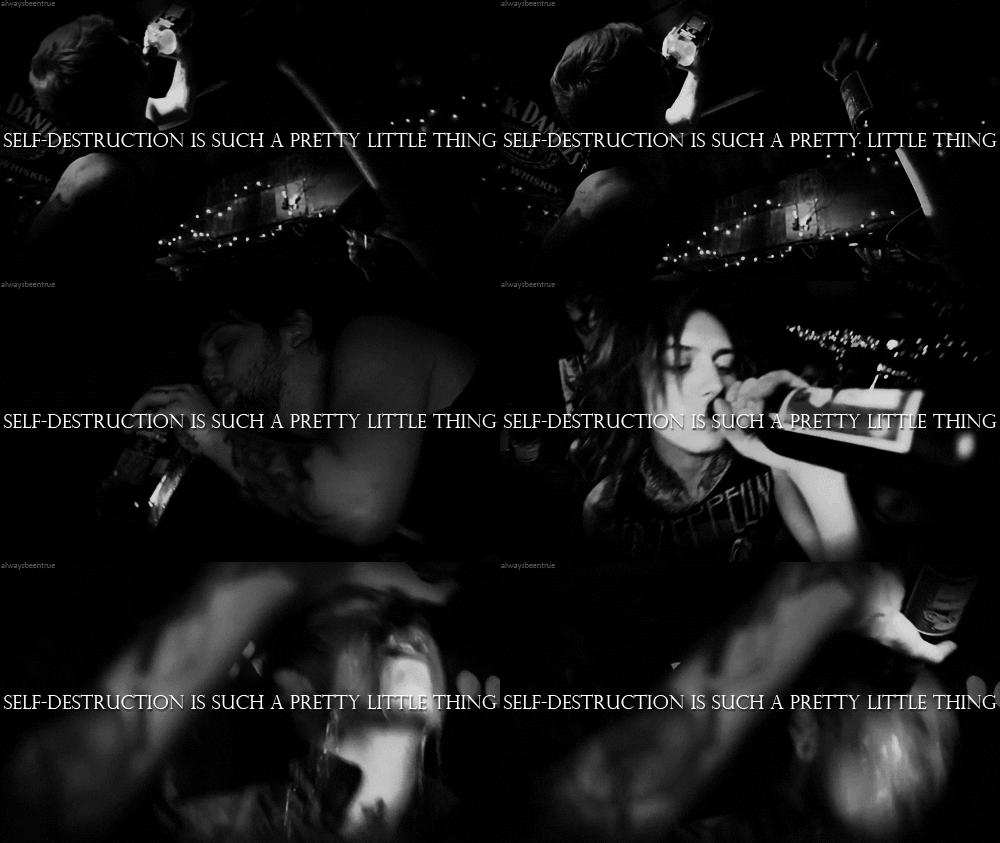
aa asking alexandria afuckinga self destruction


Source
Stevenson, Robert. The Strange Case of Dr. Jekyll and Mr. Hyde. Charles Scribner's Sons, 1886. Digitized by Google.

Possession

As I read The Strange Case of Dr. Jekyll and Mr. Hyde, I was shocked by the outcome that the two characters were one in the same. I felt that in the beginning I tended to be a bit confused by the whole plot, I just knew from the confinement of Dr. Jekyll that something about him was suspicious. After reading the story, I was just curious to know what possessed him to take the potion to become Mr. Hyde in the first place?

The potion for Dr. Jekyll is like a drug for him. He just couldn’t get enough of it! When he wanted to stop, his body wouldn’t allow him to. This potion allowed him to turn into a completely different person, the opposite of himself. In this alter ego, he was a murderer and a wanted criminal. I compare the potion to a drug because as Dr. Jekyll he would never commit such crimes but as an alter ego he is capable of any extreme.

Yet again, as we have seen in class, science came be detrimental to humans. Just as Frankenstein created his monster, Dr. Jekyll created his own within himself. Dr. Jekyll tries to escape his creation as well and utterly fails. In his case, he involuntarily becomes the monster that he created, when he wakes up from his sleep as Mr. Hyde. At first Dr. Jekyll likes Mr. Hyde because he allows him to be completely different from Dr. Jekyll, for example less human with less moral standards. As the reader, I find Dr. Jekyll to be a coward… He thinks that he can do anything and get away with it just because he is in disguise.


The most interesting part of this story to me was when Dr. Jekyll confined himself away from his servant while he was transformed. At the time I had no clue what was occurring in the story, I just knew something suspicious was about. In hind sight, now that I know about Dr. Jekyll’s creation, the solitude of the doctor amuses me. He is hiding and sending his servant out to get chemicals because he has turned himself into his monster permanently. I couldn’t imagine creating a monster alter ego for myself and then being stuck. Although I have no desire to make a monster in the first place. 

Link to picture:https://www.google.com/search?q=the+strange+case+of+dr.jekyll+and+mr.hyde&rlz=1C1OPRA_enUS594US594&espv=2&biw=1366&bih=662&source=lnms&tbm=isch&sa=X&ved=0ahUKEwjKk_SP86rQAhUYwGMKHcZ1AQwQ_AUICCgD&dpr=1#imgrc=m-x3dyVNyTcB4M%3A

Monday, November 14, 2016

Sneaking Cookies

My familiarity with The Strange Case of Dr. Jekyll and Mr. Hyde before reading it today began and ended with hearing of the title. As such, I actually had no idea that the story had to do with a split personality disorder until towards the end of the novel. But, I’m kind of glad that I had no background knowledge of Dr. Jekyll and Mr. Hyde, because going into the novel without knowing much about it allowed me to “get into it” more. I read the whole thing through without putting it down and thought it was interesting, although the language was admittedly a little difficult at some parts.

Dr. Jekyll and Mr. Hyde displays the struggle between our inner monsters and our inner heroes. We all like to declare ourselves “good people” or even heroes, as displayed through Dr. Jekyll, the upstanding (literally, and figuratively) older doctor with lots of friends; but we also have a desire to get in touch with our monstrous sides, as displayed through Mr. Hyde, the evil young man. Of course, most people without split personality disorder do not experience this to the extent as the character in the novel does, but we all have experienced this to some degree.

Think about even the most insignificant time it has happened to you… Your parents tell you not to eat a snack when you get home from school because you’ll ruin your appetite. But still, when they leave the room, you sneak a cookie. You know it’s wrong, but you still want the cookie. It’s interesting that this phenomenon occurs. We all know some things that we do are considered wrong, but we still do them. Of course, killing a bunch of innocent people is a lot more wrong than sneaking a cookie, but still. Why do we do these things, knowing they are wrong? We want to be good, but are people inherently bad?


The fact that I didn’t realize that Jekyll and Hyde were actually the same person I think adds to the novel’s motif of the struggle between inner good and evil. I personally am always inclined to see people as either good or evil, especially in works of fiction. However, as we are discovering in the many works we have read/watched in this class, people can, and do, have both monstrous and heroic qualities.


Another interesting point raised by the novel is regarding the age difference between Dr. Jekyll and Mr. Hyde. Dr. Jekyll looked/was older than Mr. Hyde. Does this mean that the author is suggesting that older people with more experience are “better” people, while younger people are more inclined to be monstrous? Although some may argue that this could be true, I think that people can be monstrous regardless of age. 

Overall, I enjoyed the read and thought the novel raised some very interesting points.

Heaven and Hell

Understanding the way Hollywood operates, it is no surprise that the basic storyline of The Strange Case of Dr. Jekyll and Mr. Hyde has been adapted and modified into various forms. One is naturally drawn to the plot based on its suspense and otherworldly depictions of the internal battle within Dr. Jekyll. Perhaps the most popular example of the story being modified for another purpose lies in the portrayal of Gollum/Smeagol in The Lord of the Rings. While reading this story, I found myself envisioning the iconic representation of Gollum by Andy Serkis. Also, there is even an upcoming film dealing with similar themes, albeit to an extreme level, called Split. Directed by M. Night Shyamalan, Split clearly draws influence from the plot of Dr. Jekyll and Mr. Hyde, but features an individual suffering from 23 different personalities. Obviously, the major themes incorporating mental illness, drug addiction, and personal accountability remain developments popularized as a result of this book.

While reading the text, I pondered over one of the more interesting motifs revolving around the internal struggle between good and evil. As Dr. Jekyll states, "...all human beings, as we meet them, are commingled out of good and evil" (Stevenson, 45). This theme truly dives into the crux of this class's purpose. As we have discussed form our previous reading, Frankenstein, everyone possesses the ability to be either a hero or monster, committing good or evil acts based on the distinction. The instance with Dr. Jekyll and Mr. Hyde, though, reveals a particularly different scenario since both personalities are polar opposites of one another. "My two natures had memory in common, but all other faculties were most unequally shared between them," said Dr. Jekyll (Stevenson, 48). The distinctiveness between the two personalities remains an intriguing allegory for the forces of good and evil within each individual.

In heavy metal music, arguable no band has held a more legendary status than that of the genre's founders, Black Sabbath. One of my favorite songs from this group has lyrical content dealing with the concept of personal good and evil. From the 1980 record of a similar title, the song "Heaven and Hell" actively portrays the dichotomy surrounding this theme. Ronnie James Dio's lyrics for the song include, "Sing me a song, you're a singer, Do me a wrong, you're a bringer of evil, The Devil is never a maker, The less that you give, you're a taker" ("Heaven And Hell Lyrics"). In the song, the concept of Heaven and Hell (i.e. good and evil) are inherent within all people. Throughout the course of our lives then, each person decides whether they act upon the good or evil that lies underneath. The essence of this track parallels a similar theme found in The Strange Case of Dr. Jekyll and Mr. Hyde.


                                          https://www.youtube.com/watch?v=fEic8-jq39Y
                                          
                                          https://www.youtube.com/watch?v=idn50Xj_CiY

I pledge that I have neither given nor received any unauthorized aid on this assignment. Anthony King

Sources:

"Heaven And Hell Lyrics." -Black Sabbath. N.p., n.d. Web. 14 Nov. 2016

The Lord of the Rings: The Two Towers (Extended Edition). Dir. Peter Jackson. New Line Home

    Video, 2006. DVD.

Split. Dir. M. Night Shyamalan. Universal Pictures, 2017. Film.

Stevenson, Robert Louis. The Strange Case of Dr. Jekyll and Mr. Hyde. New York: Dover

    Publications, 1991. Print.