Showing posts with label astonishing x-men. Show all posts

Monday, September 19, 2016

Comics: an Acquired Taste

For me, comics are like beer. Maybe with time I'll start to like them but after my first taste, I'm still not loving the flavor.  Maybe its not that I don't like comics but I just haven't tried enough of them to know what I like. But one thing is clear after this reading; I'm not a fan of the Astonishing X-men. 

I was basically confused from the start as I was only able to identify Cyclops and the blue cat guy (Who's name I discovered later is Dr. McCoy). It was easy to follow the plot and once Wolverine showed up things started to get a little clearer as he’s usually the cause of conflict. But then suddenly they were all giants, standing in the ocean…

I honestly thought I skipped a page and flipped back because I couldn’t understand how they transitioned from the lawn to giant form and an ocean (I’m obviously the person on the hike who’s got the map because if I don’t know where we’re going I get very annoyed). After Dr. McCoy explains that he messed something up with the danger room, I see the humor in it but I felt like it was so abrupt. But I felt like this a lot. It was a constant jump from one scene to the next and it was complicated to follow.

I honestly have no clue what Frost’s powers are. She can read minds but manipulate them but also she turns into diamond (I think I’m confused here…)? She’s fighting Ord and she becomes a diamond. Not sure what happened. Maybe some clarification is needed. Then in the next scene there’s a mini dragon that attacks the bad guy and saves the X-men. It apparently belongs to Kitty but why? I’m not sure. A tiny purple dragon saved the day and well… I thought that was pretty lame. I think if the alien had still kicked all their asses and then simply walked away, there would’ve been an added layer of mystery. The dragon just seemed a little much.

It did get better from there and I started to get more into the story line. Where the heck is the professor? What’s the alien Ord doing with the doctor lady? Who’s the little girl? What’s going on with Jean?!

My issues with this weeks comics stem mostly from randomness that doesn’t really add anything to the plot and over-stimulating pages. Sometimes there was just way too much going happening on a page and every single character had dialogue (a lot of it side comments or snarky remarks). While it does make the conversation seem more genuine, the side comments in combination with the main dialogue in combination with the intense, in your face artwork makes it really hard for me to focus. There’s just too much happening.

Too much happening! 


For instance, what is happening here?                                        
What's that top bit about? What moth? Help. 

I really do wish I liked comics, in a very sincere way. But, like beer, I’m afraid I’m going to have to push through a lot of the ones I don’t like to find the few that suite my taste.

Astonishing Jean?

In the Astonishing X-Men issues one through three, I was shocked to see the leadership of Jean throughout the comic. This makes me wonder if there are subcategories of heroes. I would also argue the same for monsters. For now, I am focusing on the subcategories of heroes and specifically Jean’s standing in the hero category.

In my thoughts I would consider all of the X-Men heroes, but they are all different calibers of heroes. In the comic issues, Jean stuck out to me the most. She was the leader of the heroes and I would consider her the superhero of the group. She does everything in her power to help others, she is almost selfless to a fault. When the X-Men help Nina and the Mannites to protect them from the Death, she is willing to sacrifice herself in order for the Mannites to live long enough to “discover their powers and decide their own fate”.

Along with Jean’s selfless nature, she is the leader of the group throughout the comic issues. When an event arises or action needs to take place all of the characters look to Jean for instruction. For example in the third issue, Nate says “You call the shots, Jean”, Jean acts as the mission leader throughout the quest.

In class we’ve agreed that a superhero acts in a selfless manner and has some type of power that makes them superior to the average hero. As far as powers in the X-Men comics, telekinetic power is definitely the strongest of them all. Jean’s telekinetic energy makes her an obvious choice as a leader.

I feel like Jean’s role in the X-Men movies was underrated immensely. Why would such a central comic characters role be substantially diminished in the movie? Jean serves as the character that overshadows all of the characters to a character in the film that would show up everyone in a while. Does that make sense to anyone else? It sure doesn’t make sense to me!

[Joss Whedon (w) and John Cassaday (a).] Astonishing X-Men, Vol 1. "Gifted" #1-3. (Dec. 2012). [Marvel Comics].

My First Real Comic

I like the X-Men.

Yup, I really never thought I would say that about any superhero series, but I do. I like the X-Men. Granted, I feel like I liked the X-Men, as characters, more in the films we watched than in The Astonishing X-Men. Why?

The superhero part.

When Cyclops suggests the X-Men become “a real superhero team,” it was almost like a joke to me. I think what really drew me to the X-Men in the films was that although they had powers and acted like superheroes, they didn’t need the trivial “tights” and costumes to fight for their goal.

However, that’s not to say I didn’t enjoy the comics, because I really did! They were entertaining, funny, well-drawn, and well-written. I really appreciated the Harry Potter references (you guys didn't expect me not to comment on the Potter references, right?)  I also think the comics, like their film counterparts, displayed the fact that there is a gray area between heroes and monsters. Not only because the characters are themselves “monsters” or mutants, but because in these comics, some characters which you would think would be heroes, in fact are not.

One instance where the gray area between monsters and heroes occurs is in relation to Dr. Rao’s “cure.” Doctors are traditionally thought of as “heroes,” and in this instance, I see how she can be considered a monster. Sure, she thinks she is saving Tildie from her powers; maybe she is. However, her intentions, I believe, are not so pure, for when explaining the cure to McCoy, she says, “innocent people will live normal, decent lives.” To me, this sounds like she wants mutants to live “normal, decent lives.” Although she of course isn’t forcing anyone to take the cure who doesn’t want it, she has to know that this kind of thing could affect mutants everywhere. Additionally, I feel my suspicions of Dr. Rao’s intentions could be proven right, at the end of episode 3, we get a hint that the cure could have been tested on Jean.

This same idea where a figure of government authority who should be considered a hero also shows up in Cyclops’ meeting with Fury. Again, a government figure who you would think would help, instead groups all mutants as one evil entity – “your boy Magneto” – and says that the X-Men are harboring “dangerous criminals” at their school, including Frost. (Disclaimer: I don’t know Frost’s backstory, so I can’t really comment on that part, but…) Anyway, Fury does not seem to be a hero figure of any sort.

On an unrelated note, I just wanted to comment on the fact that Frost annoys me. She really needs to put on some clothes…

A final example of how the Astonishing X-Men show the gray area between villains and heroes has to do with McCoy. Although he is part of the X-Men superhero team, he could potentially stray and try the cure on himself. A true hero is selfless by our definitions, and that is definitely a selfish act.


In conclusion, though: I liked reading my first real comic.

Are the X-Men Suffering from a Disease?


People with diseases tend to be surrounded by a strong stigma.  The word disease itself has such a powerful negative connotation that we're automatically repulsed by the thought of it.  The Oxford English Dictionary defines it as “a condition of the body, in which its functions are disturbed or deranged.”  In Astonishing X-Men: Gifted, a new “cure” for the mutation “disease” is being released by Dr. Rao.  This cure, she says, is able to eradicate the disease.  Some mutants are strongly opposed, whereas others desire it. Any mutant seeking the cure may feel alienated from his or her own sense of self, such as Dr. McCoy.  He expresses to Logan that his body isn’t what it used to be and he feels out of control of his emotions.  Dr. McCoy, and perhaps many other mutants, just want to live the lives they used to have.

However, other mutants are opposed to the mutant cure, and rightly so.  After all, is being a mutant so horrible? Mutation can be viewed as a quality that simply makes a person unique—it isn’t necessarily dangerous or bad.  Some mutants, such as Kitty, have rather harmless abilities.  In other cases, a mutant only needs to learn how to control their abilities.  If a mutant’s regular functions are not disrupted, then a cure isn’t needed because mutation is not a disease.

A mutant’s choice over whether or not to “cure” themselves is not quite as troubling as Dr. Rao’s presentation.  She begins her speech by stating that mutants and non-mutants are equals, except that mutants have a disease.  Due to the connotation of “disease,” she indirectly infers that mutants are defective people.  She further supports the stigma surrounding people with disease (mutants in this case) by presenting Tildie, a young girl that uncontrollably causes her nightmares to become reality.  Overall, Dr. Rao highlights the possible danger and threat of mutation and presents it as the norm. 

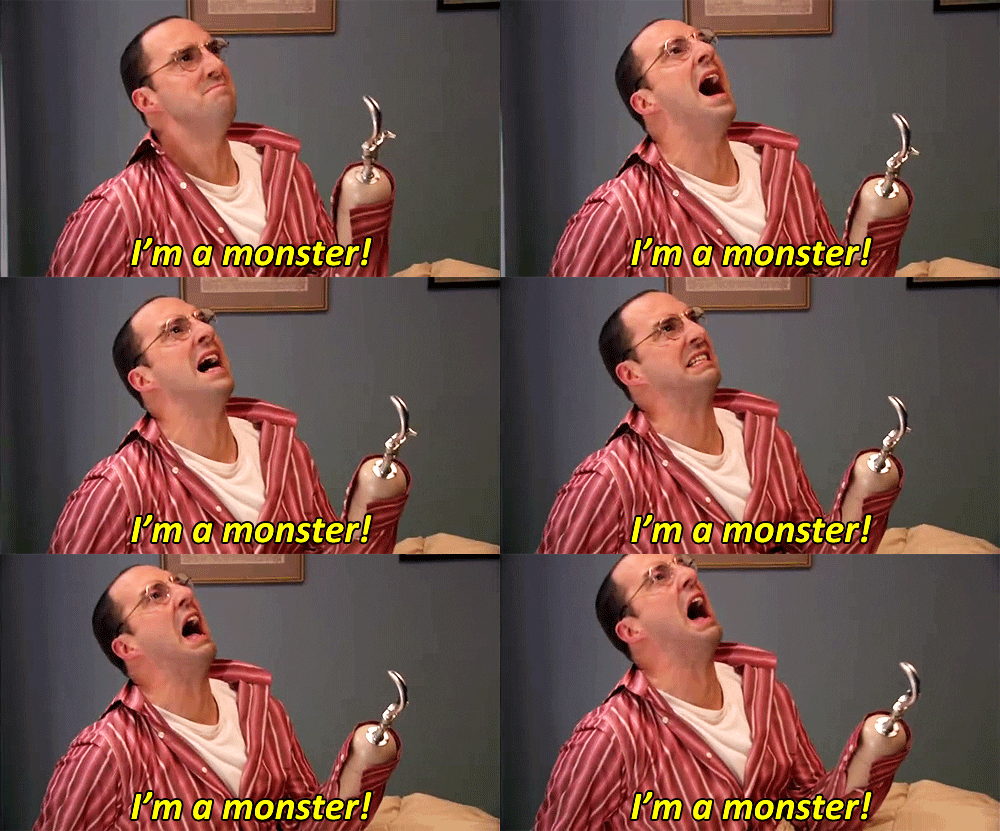
In the third issue, we see that Dr. Rao may be more corrupt than what we initially made her out to be is allied with Ord (remember the alien that attacked the X-Men?).  She speaks with Ord after giving a cure sample to Dr. McCoy, and it is evident that they are working together towards some yet-to-be-determined goal.  It is even revealed that Ord’s people helped Dr. Rao produce the cure, but she is only “a pawn…in a grand scheme” (58).  Additionally, she’s been testing the cure on someone, causing Dr. McCoy to call her a monster.  To truly know whether or not Dr. Rao is a monster, however, we’ll just have to finish Volume 1.


References:

[Joss Whedon (w) and John Cassaday (a).] Astonishing X-Men, Vol 1. "Gifted" #1-3. (Dec. 2012). [Marvel Comics].

"disease, n." OED Online. Oxford University Press, September 2016. Web. 19 September 2016.

The Outer Beast

To me, one of the more interesting individuals in the X-Men universe is the character Dr. Hank McCoy, commonly known as Beast. He exhibits traits of extreme genius, but physically resembles a large, blue, and hairy cat with incredible strength. Certainly, the plot developments within Joss Whedon's Astonishing X-Men reveals Beast as more of a three-dimensional character. From the example of Beast in this comic series, one can begin to discern what it means to be a monster. Unfortunately, no matter what Beast does, though, I fear he will always be treated as a monster due to his physical appearance.

My definition of a monster is centered around the idea of a deformity that is considered abnormal in society. However, in Beast's case, he drew the shortest straw with his mutation. Some mutants can easily pass as regular people without anyone recognizing their extraordinary abilities. Beast, on the other hand, cannot hide his mutation from the world, as seen in this comic so far. The name Beast alone implies a monstrosity. All too often, people associate their notion of monsters purely by looks instead of actions. Beast fits this concept based only on the exterior presentation that the world sees. Cyclops even refers to this perception in the comic stating, "Hank's articulate as anything, but what people see is mostly...well, a beast" (Whedon, 18). Beast's brilliance and personal stance to fight for the people of Earth are overlooked not only because he is a mutant, but also due to his outer characteristics.

With this backdrop, one can understand why a character like Beast would be curious with the possibility of a cure to the mutant gene. One of my favorite panels in the comic is at the bottom right corner of page 40. Beast is asked by a reporter about his thoughts on the supposed "mutant cure." In response, Beast says, "I'm sorry. 'Cure'?" (Whedon, 40). The artwork within the panel alone speaks to the subtle intrigue that he has with the possibility of a cure. From that point, the artist John Cassaday's rendering of Beast depicts a character struggling with the inner turmoil to become "normal" or accept who he is as an individual.

Aside from the fact that he may be degenerating further into an animal-like creature, inside, Beast longs for a chance to perform activities in which he had grown accustomed to before his mutation. On page 66, Beast says, "I used to have fingers. I used to have a mouth you could kiss..." (Whedon, 66). Understanding the position that currently resides within him, one can easily surmise why he would seek out a cure should the opportunity present itself. For as Emma says at the top of page 11, "They will always hate us" (Whedon, 11). Personally, I can not blame Beast for wanting to seek a cure with the constant demands that humanity enforces on the mutant community.

https://media.giphy.com/media/rej07KlIYlax2/giphy.gif


I pledge that I have neither given nor received any unauthorized aid on this assignment. Anthony King

Sources:

Whedon, Joss, and John Cassaday. Astonishing X-Men: Gifted. New York: MARVEL
       
            WORLDWIDE, 2004. Print.

Friday, September 16, 2016

Survival with Tights

We are all aware of the discrimination X-Men deal with time and time again for their mutation. So are we going to get something different this time? Nope! And I don't care, I am 100% biased when it comes to X-Men. I will most likely love everything that has to do with X-Men (even that one movie that we never talk about). Just a quick disclaimer before you go on with this post.

The X-Men want to be accepted and they want to be part of society as equals. BUT what they want above anything else is to survive. Survival is at the core of everything. We discussed this last class when we were talking about art. I argue that everything stems from survival. We eat to survive, we reproduce to keep the human race alive, we create technology to make it easier to survive, and so on. Survival is a theme in X-Men. In Astonishing X-Men, whether they admit it or not, the X-Men are doing whatever it takes to survive (at least within issues 1-3, we'll see). Yes they are treated unfairly, yes they are oppressed, but forget about all the social injustices. Those injustices do not matter if they are all dead. So Cyclops decided to bring some of them together and not just "make nice with the public," (23) but "astonish them" (24). Public opinion is crucial to the survival of the X-Men (duh).

Emma Frost gave that depressing speech/warning about how humans will always hate them, they can never trust them, and how they will never be at peace (10-12). It seems like there is no hope for the mutants, so why even try to get the public to like them? Because they see that the Avengers, S.H.I.E.L.D., Fantastic Four and all of the other superheroes are not just tolerated, but loved at times. Cyclops thinks that by mimicking them and creating a team of superheroes, the people will automatically change their perception. He thinks superheroes' tights or spandex will help them survive.
https://media0.giphy.com/media/114AZ0sxe9dyMM/200_s.gif
There is one thing that he is forgetting: mutants are people who developed these powers without any explanation. The Avengers, the Fantastic Four and even S.H.I.E.L.D. obtained their powers either because they are aliens, there was some scientific experiment/accident, or just through training. In other words, they have an explanation for being different. It does not matter that the X-Men created a superhero team, the costumes they wear, the people they save. or how many worlds they save. Nothing matters because the humans will always see the mutants as a threat to their survival. They see them as the "next step in evolution... the end of humankind" (25). Just think about how many times you were intimidated by someone who you thought was stronger, smarter, or more attractive than you. Whenever that happens to me, I feel threatened by their perceived superiority. My instincts tell me to either stay away from them or one-up them somehow. The humans are also doing whatever it takes to survive. The humans however, have the support of the government and other non-mutant superheroes. The mutants have no one. Even Nick Fury and S.H.I.E.L.D. will not help them because they are seen as threats, not allies. The mutants are on their own.
https://lovelace-media.imgix.net/uploads/1143/9983e210-0403-0134-24a3-0e1b1c96d76b.gif?