Showing posts with label Magneto. Show all posts

Monday, November 28, 2016

Attack of the Social Media Zombies

Although I do not find gore-filled depictions of zombie apocalypses particularly scary, the idea of turning into just another member of a zombie horde is unsettling. Being human involves being an individual and having some sort of agency over our own decisions. A zombie, on the other hand, merely obeys its base instinctual drive to consume and spread. Even a small scratch from an infected host could lead to your undying allegiance to the undead horde, and the odds of surviving a zombie apocalypse decrease as the size of plague grows. The only hope you have left is for time to take its toll on the rotting carcasses and decay their flesh from the bone.

http://i.imgur.com/ms6iWay.jpg
The tragic reality of living in a zombie infested world is that you must become like the zombies themselves in order to survive. In The Walking Dead, the lead protagonist, Rick, learns this through his struggle to keep his family and himself alive. Rick learns the dangers of interacting with both the living and the un-living, rationalizing his problematic decisions with the axiom, “you kill, you die”. As Rick begins to fully comprehend the state of his world, his view changes to “you kill, you live”. Rick is becoming a zombie himself, not through infection, but by aligning his core motives with that of the undead. His zombification will be complete when he begins to believe ‘you live to kill’. At that point, there is no turning back.

http://media.caglecartoons.com/media/cartoons/136/2016/07/11/181927_600.jpg


The parallels between zombie plagues and modern consumer culture are what I find truly terrifying. Commercial and ads are now constantly hiding away in our pockets. Aside from phones turning people into real world equivalents of zombies (ex. Pokemon Go zombie outbreak of 2016), phones provide a way of reinforcing mob behavior. Technology has allowed us to condense everything into a small package to be easily consumed through social media, and this ease of consumption is what makes social media addictive. Social media is built around virulent behavior through its use of likes, shares and retweets. A good example of virulent mob behavior produced by social media are ‘challenge videos’. This viral sensation causes the host to upload a video of themselves preforming a ‘challenge’, ranging from pouring ice water on their head to eating spoon-fulls of cinnamon for no apparent reason other than being part of the collective. The social media zombie functions similarly to the fiction zombie, obeying its base instinctual drive to consume and spread, but, in this case, consume and spread kitten videos, 'dank memes', and BuzzFeed articles.
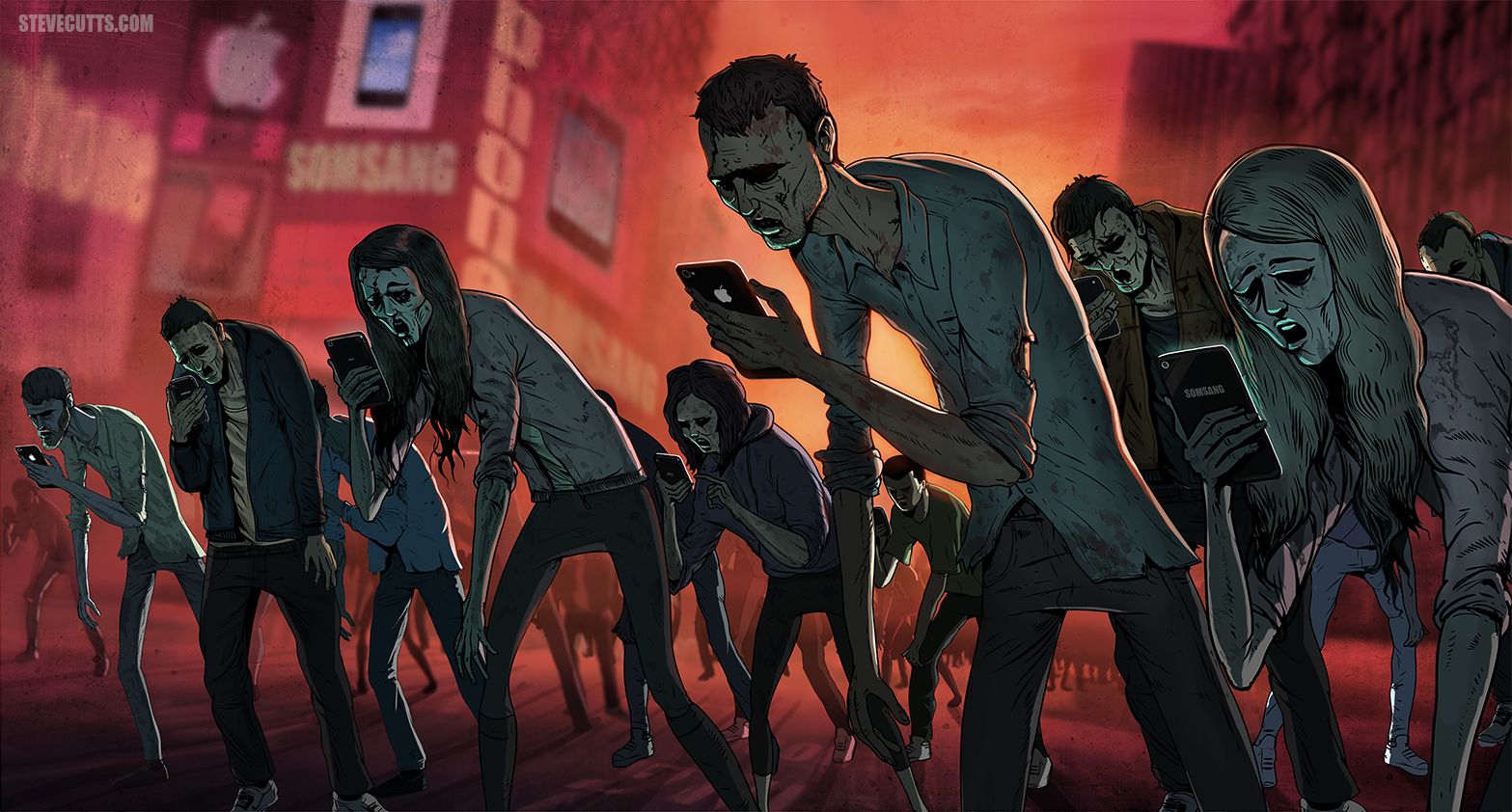
http://www.zerotoalpha.com/wp-content/uploads/2016/09/social_media_zombies.jpg
I believe our own society is reaching a point of no return, where our social media zombification will be complete. We are transitioning from ‘you consume, you live’ to ‘you live to consume’. Living without participating in social media is becoming more difficult. In order to survive in modern society, one must become a social media zombie. So share those hashtags, click on some ads, enjoy those ‘dank memes’, and join the rest of horde.

Tuesday, October 25, 2016

Beowulf and Revelation

After reading Beowulf for a second time, I began seeing similarities between Beowulf and apocalyptic biblical literature. The story of Beowulf is rich with Christian subtext as seen through the backstory of Grendel's lineage. Apart from Beowulf resembling a messianic figure in the story, he also resembles Archangel Michael from the Book of Revelation.

http://67.media.tumblr.com/tumblr_l7i7esa09K1qcr6iqo1_1280.jpg
http://67.media.tumblr.com/tumblr_l7i7esa09K1qcr6iqo1_1280.jpgn

Revelation 12:7 - 12:9 (KJV)

7 And there was war in heaven: Michael and his angels fought against the dragon; and the dragon fought and his angels.
8 And prevailed not; neither was their place found any more in heaven.
9 And the great dragon was cast out, that old serpent, called the Devil, and Satan, which decieveth the whole world: he was cast out into the earth, and his angels were cast out with him.


Both are righteous warriors fighting against the forces of evil. Beowulf even fights against a dragon for his final battle. I think this represents Beowulf fighting against Lucifer himself, but what about the other two monsters Beowulf faces? Do they resemble other evil biblical characters who would side with the Dragon?

There are many parallels between Grendel and Cain. The story explains that Grendel's monstrosity was due to his relation to Cain, the original murderer. Apart from the direct connection between the two established in the story, both Grendel and Cain killed out of jealousy. Having his offering rejected by God, Cain murders his brother Abel, who was favored by God, out of spite. In the same vein, Grendel kills the Danish warriors in their sleep for enjoying luxuries he was cursed to live without. I think this is used to represent Beowulf vanquishing Cain and his lineage, who would be fighting against God in the final battle.

http://vignette2.wikia.nocookie.net/biblestudy/images/0/02/Cain-Abel.jpg/revision/latest?cb=20160716193740

Grendel's mother could be said to also represent Cain's lineage, but I think she has many similarities with a less known apocryphal character from Judaeo-Christian tradition. Grendel's mother parallels Lilith, a figure in Jewish biblical mythology who is said to be Adam's original wife.

http://www.supernaturalwiki.com/images/thumb/1/1e/Lilith-JohnCollier.jpg/150px-Lilith-JohnCollier.jpg

According to the myth, God created man and woman at the same time during Creation. God wanted Lilith to be subservient to man, but she refused and, as a result, was exiled from the Garden of Eden. The creation story then proceed as usual, having Eve created from the rib of Adam. The character of Lilith is portrayed as a demonic female which is fairly similar to the depiction of Grendel's mother. One telling of Lilith's story has her bearing a child with Adam prior to her departure from the Garden. This child was Cain.

It would be very interesting to see how other mythologies, especially Scandinavian mythology, influenced Beowulf as each has its own portrayal of the battle between good and evil.
 

Monday, September 5, 2016

The Origin of Magneto

In most forms of media regarding heroes and villains, origin stories of characters help to provide context and background. For people either watching or reading about the character, the origin story gives a glimpse into the reasons for the mission and actions that a character undertakes. In regards to the former X-Man and member of the Brotherhood of Mutants Magneto, the chilling images from the opening scene of the first X-Men movie reveals the heartbreaking events that created the anti hero. Without this context, the audience could not formulate a complete rendering of Magneto the individual. As a result of his origin story, Magneto becomes a more well-rounded character, enabling individuals to create a sense of understanding for the often misunderstood mutant.
At first glance, Magneto seems to be the one of the main antagonists of the X-Men storyline. However, as the first scene of the 2000 film X-Men shows, Magneto is not only a mutant, but also an individual of Jewish descent, suffering through the events of the Holocaust during the Second World War. This pivotal scene depicts the selection process at Auschwitz and continues to remain as an enduring image to the opening of the X-Men saga. A young Magneto discovers his mutant powers as a result of the traumatic moment involving the separation from his parents (X-Men). Certainly, such an experience would have a lasting effect on the psyche of the young boy, breeding traits of resiliency, self-reliance, and a desire for safety and control within himself.
For the second time in his life, due to his differences, Magneto has been designated as an outsider, someone who is feared, suppressed, and exploited. Sadly, Magneto lost his family in the events of the Holocaust and witnessed firsthand the lengths that humans will go in order to control perceived enemies. As Magneto himself states in the film X-Men, “Mankind has always feared what it doesn’t understand” (X-Men). Having seen the destruction and sorrow which mankind can enforce on minorities without power, one can empathize with Magneto’s approach to defend and protect his mutant family by any means necessary.
This context helps one to comprehend his actions in the movies X-Men and X2 when he attempts to thwart the Mutant Registration Act as well as join the X-Men in defeating Stryker (X-Men, X2). Interestingly, Magneto does not even view himself as the “bad guy” in the story. In X2, Magneto questions, “Is that what they call me?” when told by fellow mutant Pyro that he is referred to as such (X2). Despite the fact that some would consider him to be a monster, Magneto purely does whatever he feels is needed in order to save his mutant family from the fearful humans. Although one does not have to agree with his actions or methods, Magneto’s backstory aids in humanizing his character and establishing an explanation for his ruthless and often uncanny approach to mutant-human relations.

Sources:

X-Men. Dir. Bryan Singer. By David Hayter. 20th Century Fox, 2000. DVD.

X2. Dir. Bryan Singer. By Bryan Singer. 20th Century Fox, 2003. DVD.

I pledge that I have neither given nor received any unauthorized aid on this assignment. Anthony King