"Taken individually, the pictures below [not pictured] are merely that - pictures. However, when part of a sequence, even a sequence of only two, the art of the image is transformed into something more..." (pg. 5)
Central to the idea of the comic is the concept of sequence. There is an order to pictures/words/images/events/etc that gives them meaning. The narrative of a particular text is meaningful because of the sequences that interact (plot, characterization, the various nuts and bolts of a story) inside of it. It's progressive - image A leads to image B leads to image C (for example), and so on and so forth. Long story short: a sequence makes a narrative.
It doesn't even have to be a linear narrative - the sequence that makes up a non-linear narrative is still a linear sequence, because time is still just one of the thing that make up a text. Star Wars is actually a great example of this: narratively, it opens in media res, but A New Hope is the first movie sequentially - even though it is fourth in the timeline.
(messing with your preconceived notions about narrative and timelines since 1977)
McCloud brings up the idea that "space does for comics what time does for film" (pg. 7) Comics are spatially sequenced; the space between them is the sequence. Comic action happens in the blank lines between each frame. To help myself visualize this, I remembered my junior year of high school, when I had to learn about early photography in either Photo 2 or AP Art History. Here are the frames of Eadweard Muybridge's work with horse racing:
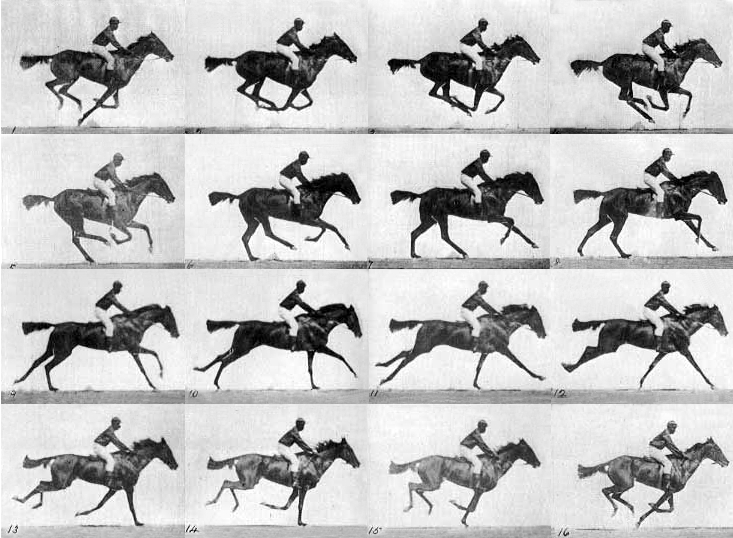
Eadweard Muybridge, Human and Animal Locomotion series, 1887
Now here's the same thing, only animated:
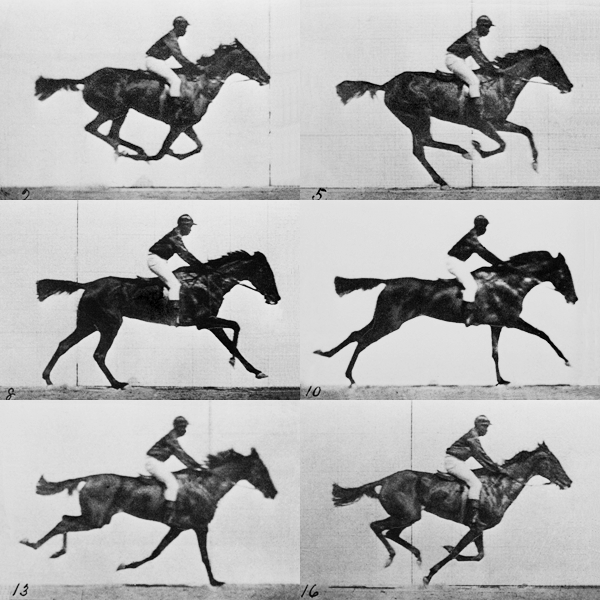
(same citation, but accessed on Wikipedia)
There's still a gap from point A to point B. If you look at the sheet (if you want to call it a storyboard, I guess you could - I'm pretty sure there's a term for all those frames lined up, but I can't remember what it is) you see that there's missing action - we don't see the horse's leg go from straight to bent. That's action we missed, that we didn't see. The meaning is not only in points A and B, but how we get there, the space that makes them different.
(A random aside: I was thinking about how so many comics are adapted to film, and I began to wonder if filmmakers in general don't like to read comics because comics are so reminiscent of storyboards - maybe almost like comics are unfinished, unrefined bits of a larger work? Or maybe they like to read them for much the same reason? I'm not sure. Who knows?)
Sources:
McCloud, Scott. Understanding Comics:. New York: Harper Perennial. 1994.18. Print.
