Showing posts with label Cameron Rogers. Show all posts

Tuesday, November 29, 2016

Shambling Around the Ivory Tower

Monster Culture in the 21st Century truly is the gift that keeps on giving. A collection of 20 or so essays by various academic sources, the book consistently demonstrates the same approach to analyzing the world through popular culture - present arguments under a guise of concern for disenfranchised peoples while attempting to mask the smug contempt most of the contributors hold towards them. Often, the true feelings the authors hold bleed through into their essays, forcing the reader to question how genuine their arguments truly are.


In his essay for chapter 14, Michael S. Drake seemingly defends the poor and impoverished against what he considers typecasting by zombie fiction authors. Drawing back to older zombie movies and Haitian voodoo beliefs, he criticizes various facets of zombie fiction as power fantasies where the wealthy and privileged can wreak havoc on the lower classes without remorse. However, the comparisons he draws and language he uses suggests a complete disconnect with the working class. He directly compares recipients of welfare and the proletariat to mindless, shambling, flesh-eating zombies. He implies that they would not be aware of this without academics such as himself explaining the concept in great detail. Furthermore, he shows contempt for the upper classes by portraying them as violent brutes who would happily indulge in horrible acts of violence if there were no consequences for their actions. 

His attitude is that of superiority and disdain for anyone outside of his inner circle, which is shared by several other authors in the book. Mary and Carmen Lugo misconstrue the plot of Lakeview Terrace to reinforce their argument in chapter 15, showing either an indifference towards the audience or a lack of integrity on their end. The contributors of Monster Culture seem to, for the most part, thumb their noses and sneer at their own "Others," whether they be blue collar rural Americans or people with higher salaries than they have.

The entire affair reminded me of the Hamilton Boycott and backlash. On both ends, the controversy about the musical was silly, but the responses to the calls for a boycott were anything but. Celebrities and left-leaning figureheads mocked those who supported the boycott, making fun of their lower social standing, education, or inability to purchase tickets. The same people who claimed to stand for the working class in the election demonized those within that very class for not sharing their views.


This sense of superiority isolates people like Drake from the issues everyday people face. In their eyes, their "Other" is just too ignorant to help, and should be subjected to humiliation and shaming tactics. A similar issue plagued some mainstream news outlets during the election. Academics need to be willing to leave their ivory towers and try to understand ordinary people - even those who might not be near them on the political spectrum, or *gasp* did not vote for Hillary Clinton. Political tensions are high enough, so it might be time to drop the narcissism and the buzzwords for some respectful discussions.

Of course, people like Drake could go on living in echo chambers and getting their opinions bounced back to them by their colleagues. It's not like ignoring a changing political climate has ever backfired for people like him before, right?


WORKS CITED:

Levina, Marina, and Diem-My T. Bui. Monster Culture in the 21st Century: A Reader. New York: Bloomsbury Academic, an Imprint of Bloomsbury Plc, 2013. Print.

Thursday, November 3, 2016

Bridging the Gap: Frankenstein and This Dark Endeavor

Reading Gris Grimly's Frankenstein for the first time, I felt like I was revisiting an old friend that had vanished for months on end. In spite of what that comment might suggest, I am not talking about reading Frankenstein from the new illustrated perspective (although I am sure that is a fascinating topic to talk about as well). Rather, I am referring to the "head start" on Frankenstein I got by reading Kenneth Oppel's two prequels to it, This Dark Endeavor and Such Wicked Intent.


This Dark Endeavor and Such Wicked Intent take place in Victor Frankenstein's adolescent years, focusing on events mentioned in passing throughout the original novel by Mary Shelley, like his search for the elixir of life. I did not pick these novels up from my love of the classic gothic novel; rather, I am a massive fan of Oppel's works. He is one of my greatest inspirations for writing because of his creativity and world building skills. I remember staying up into the long hours of a Tuesday night finishing Such Wicked Intent, enraptured in its conclusion despite knowing how much the next day's practice would hurt on four hours of sleep.

Reading Frankenstein for the first time after finishing those two books has made the exercise into a series of revelations and obscure references finally making sense for me. The bolt of lightning that inspired curiosity in Victor early on in Frankenstein acted as the conclusion of Such Wicked Intent, foreshadowing his future in reanimating the dead with energy. Similarly, his quest to resurrect the dead becomes more tragic having read This Dark Endeavor, serving as a dark mirror to his previous mission to save his dying brother from a mysterious illness.

With this background in mind, reading Frankenstein is a lot like playing Minesweeper. The biggest difference is that, instead of losing when I click on an unusual square, an invisible connection between the books is finally created for me. In a strange way, it's immensely satisfying to "get" the books with the original context in mind. I may have to reread them to see what other hidden references will be uncovered with this new perspective.


I am certain some plot threads from Oppel's prequels may have been single-serving, like Victor's twin brother Conrad, the love triangle/quadrangle, and Elizabeth's implied interests in the occult and "darker" sciences. Regardless, I am eager to continue the novel and see what else is in store. Grimly's artwork has undoubtedly made this journey much easier for me than reading a wordy Victorian novel would. Not that I mind Victorian novels - A Hero of Our Time and The Count of Monte Cristo are classics in my eyes - but he has made the story more approachable for time-cramped people like me.

Like that coin toss in No Country for Old Men, everything just lined up perfectly to make this reading of Frankenstein a unique one. I intend to make the most of it.

Works Cited:

Grimly, Gris, and Mary Wollstonecraft Shelley. Frankenstein, Or, The Modern Prometheus. Vol. 1. New York: Balzer Bray, 2013. Print.

Oppel, Kenneth. This Dark Endeavor. New York: Simon & Schuster, 2011. Print.

Oppel, Kenneth. Such Wicked Intent. New York: Simon & Schuster, 2012. Print.

Monday, October 24, 2016

Beowulf Revisited Half a Decade Later

My first and last encounter with Beowulf and Grendel was in my sophomore or junior year of high school. I remember enjoying the classic English epic poem, and appreciating the analysis and snark from John Gardener's take on the legend. Coming back to the text years later, I was unsure of what to expect. Could Beowulf hold up to my existing memories of it?

Not really, no.

Several issues rose up during my return to Beowulf. First, the poem was far more flowery and descriptive than I remembered. Prose can be beautiful if pulled off subtly and with enough skill, but Beowulf's overly-long descriptions drain any enthusiasm I have for getting the scene established. Not helping is the fact that I already knew of every twist and turn the story would take. I had avoided getting the book spoiled prior to my first reading of it. Today, though, I saw everything coming and plodded along.

The greatest problem I have with revisiting Beowulf is that there is little to no room for speculation and analysis. The way the story is written gives the characters very basic motivations for their actions. Unless you really stretch the material, you cannot theorize on much the story has to offer.

Because of the last issue in particular, this blog post will be shorter than usual. I still look back on the poem fondly, though. It has its merits, and should still be taught in English classes.

Side note - somehow, I still remember some parts of the comedy version of Beowulf my high school English teacher gave my class for April Fool's. Beowulf made a string of hand-related puns after defeating Grendel, called Unferth a poser, and was oddly specific on how many men he would take to assist the Danes.

Friday, September 23, 2016

Deus Ex and Posthumanism

When I see the word "Posthumanism," the first thing that comes to my mind is the "Deus Ex" videogame series. This is with good reason, of course - the games, particularly the original and its prequel, center their stories around the development of wide-reaching artificial intelligence, human augmentation, and struggles between ordinary humans and their augmented counterparts.


Deus Ex, released in 2000; and Deus Ex: Human Revolution, released in 2011, are first-person role playing games published by Eidos and Square Enix respectively. Both are well-known for their intricate plots that tie current events with potential future issues and conspiracy theories. The appreciation for the games is so strong that it gamers often joke about reinstalling them if they are ever brought up.

Though the two games I am focusing on are divided by age both in the story and real life, they both cover posthuman topics through thought-provoking conversations and dialogue.

Human Revolution takes place in 2027, during the "Golden Age of Human Augmentation." Millions of people across the globe have installed mechanical limbs and other improvements onto themselves, improving countless lives while also creating resentment among non-augmented individuals.


Adam Jensen, the player character, is a security officer who was narrowly saved via extensive augmentation after a terrorist attack destroyed his workplace. Though this gave him powerful abilities, he had no say in his fate, leaving him in a self-loathing state for part of the story.

The game indirectly asks what it means to be human. Some characters, like the Purity First militants, insist that augmentation soils the basic idea of human growth and development. Others, like Sarif Industries' CEO, consider augmentation to be the next step in human evolution, and work to make it accessible to as many people as possible.

Notably, no answers are given to the player for this question. Instead, it leaves you to decide for yourself. Adam has retractable blades in his arms, sunglasses built onto his face, and can punch through walls without any serious issues. His abilities may exceed that of a normal human, but is he still human? Or has he become something greater than human, something humanity should strive to become?


The original game in the series, Deus Ex, examines another philosophical question (among many others): what does it mean to be a non-human? Can they ever be considered on-par with humanity, or are they somewhere below or above us?

Taking place in 2052, Deus Ex tells the story of J.C. Denton, a UN Peacekeeper assigned to quell a terrorist movement in the United States. What follows is a mind-boggling plot about governmental overreach and humanity's tendency to worship beings "above" them, even if their origins lie with humankind.

The game's final choices hinge on deciding humanity's future and who should lead it. Should it be left in the hands of centuries-old secret societies? Or should an absolute dictator, in the form of a benevolent AI program, guide it along? Perhaps a third option, where all hints of the old order are wiped away and mankind is forced to fend for itself?


Morpheus, a prototype for a more advanced computer, is at one point questioned by JC for its surveillance of humanity. It may be Orwellian to watch over as many people as it does, but is it not ultimately giving people what they want? We crave attention, as demonstrated by how much personal information we put on social media for people to like and comment on.

Something I noticed while writing this was the conscious effort I had to make to dehumanize Morpheus. After watching the video for a second time, I unconsciously described the AI as a "he," but deleted that and put "it" instead.

Is there anything non-physical that separates Morpheus from JC, though? They both think and react to their environments. They both provide insights on events and have greater ambitions to pursue. It even has a masculine voice and projected appearance. If it were considered a living being, would its immobile state rank it below humanity, or would its all-seeing network make it humankind's superior?

It has been a while since I played both games, but I still do not have answers for its questions. Perhaps that was the intention of their creators - to have players dwell on its topics long after completion. If so, they have succeeded. Whenever posthumanism is discussed, I always think back to Deus Ex and Deus Ex: Human Revolution.

Works Cited:

Eidos Interactive. Deus Ex. Ion Storm, 2000. PC.

Square Enix. Deus Ex: Human Revolution. Eidos Montreal, 2011. PC.

Saturday, September 10, 2016

The Second-Class Status of Comics

Having read the first two chapters of Understanding Comics by Scott McCloud, one particular passage from the first chapter stuck out to me. "For much of this century," Scott writes, "the word 'comics' has had such a negative connotation that many of comics' most devoted practitioners have preferred to be known as 'illustrators,' 'commercial artists,' or, at best, 'cartoonists'!" (McCloud 18). It was a sad reminder that, no matter how deep or thoughtful a comic can be, it will always be seen as juvenile by society overall.

Two comics immediately came to mind when I finished that page - Will Eisner's The Plot, and Art Spiegelman's Maus. I read both comics in high school, during a time when I voraciously read through much of Archbishop Spalding's fiction library. Though I had to read Maus for my sophomore English class, I read The Plot on my own time. Nevertheless, I was captivated by the combination of art and prose in both comics.


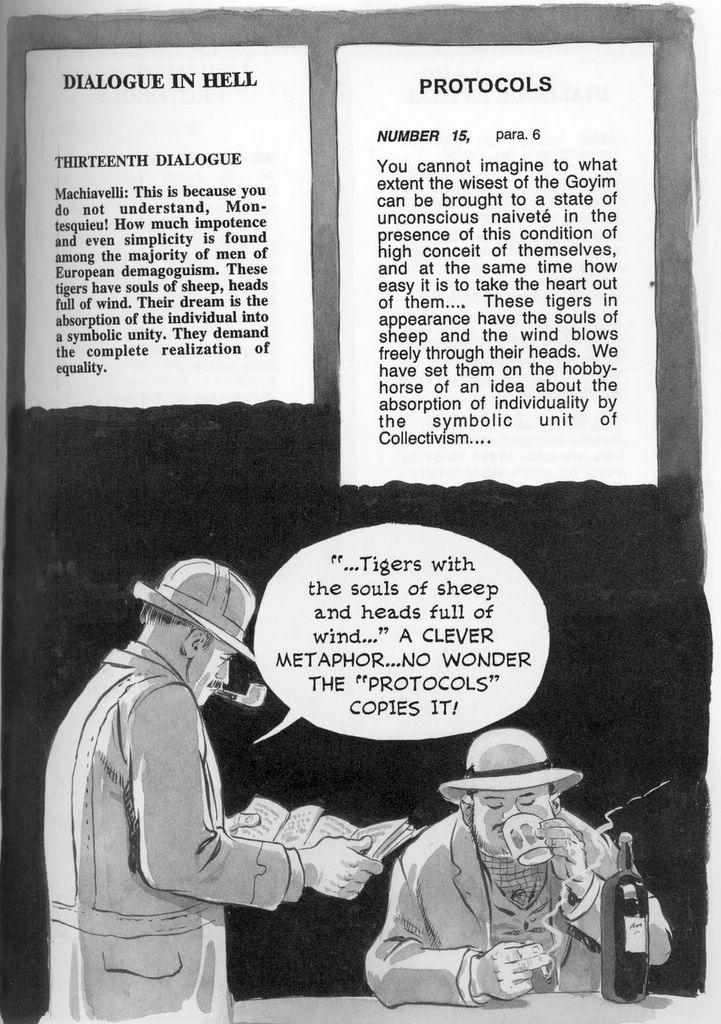
The Plot, a detailed account of the fabrication of the Protocols of the Elders of Zion, had a unique art style that combined detailed character designs with exaggerated expressions. It told a story that spanned centuries and involved disgruntled French authors and conniving Tsarist advisers desperate to hold onto power. It was a well-researched and tragic tale that kept my interest throughout its length. Why, then, is it never brought up in any way, shape, or form when high-quality non-fiction is discussed? Is it the "cartoonish" artwork that prevents critics from taking its contents seriously, no matter how thought-provoking it may be? Or did its black sheep status as a non-fiction comic keep it in obscurity? 

Of course, it is entirely possible to break free from the "ghetto" that most comics reside in, and establish a comic as serious reading material. Maus fits this idea to the T.

I remember my surprise at Maus being taught like the other books in my curriculum. While its subject matter was serious, it looked like any other comic sidelined for not fitting the standards of a "serious book." I enjoyed both volumes of Maus, as tragic as its depiction of the Holocaust was, but a question irked me throughout my reading of it: why this, and not The Plot? Both dealt with anti-antisemitism, historical events, and the depths of human depravity when dealing with "outcast" groups. Didn't both deserve credit for taking serious risks and presenting their material in an unorthodox, easier-to-consume format?

I do not think there is an easy answer to those questions. Sometimes, it might boil down to sheer, dumb luck. Critics in all fields are known for their bizarre tastes - the much-hated and generally-unfunny Ghostbusters reboot currently holds a higher Rotten Tomatoes rating than the moody, thought-provoking "Only God Forgives" and a near-equal rating with the uncompromising "Falling Down." Some practical elements may have factored into this discrepancy: Maus was published nearly three decades ago and had a stagnated release, while The Plot is only 11 years old. 

"What are you driving at, exactly?" You might ask. Well, it all comes down to this - like what McCloud said, anyone defending comics has the deck heavily stacked against them. Though the old-fashioned view of comics being for nerds and children no longer holds water today, it lingers in the backs of society's attitudes. We scoff at comics as being below us, yet we cannot put our fingers on why most people hold that view. 

Granted, for every Batman: The Long Halloween and Watchmen, there are dozens of disposable comics churned out by Marvel, DC, and other companies. But we should never allow our view of a medium to be tainted by its worst examples. Should all of literature be tossed aside because of Twilight and 50 Shades of Grey? Of course not, so why should comics be viewed as an inferior medium due to the existence of garbage like Nightcat?

Comics are undeserving of the second-class status society has lumped upon them. They deserve to be treated like any other piece of literature, not as a minor amusement.

Sources:

Eisner, Will, and Umberto Eco. The Plot: The Secret Story of the Protocols of the Elders of Zion. New York: W.W. Norton, 2005. Print.

McCloud, Scott. Understanding Comics:. New York: HarperPerennial, 1994. 18. Print.

Spiegelman, Art. Maus: A Survivor's Tale. Vol. 2. New York: Pantheon, 1986. Print.