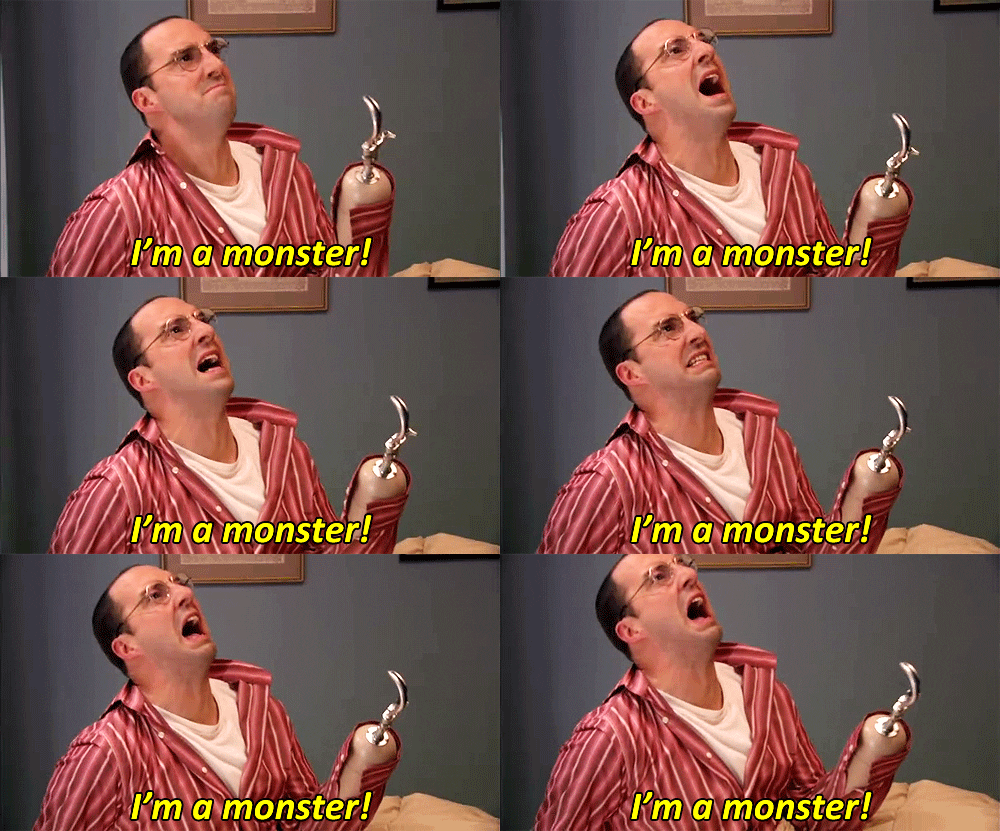
My definition of a monster is centered around the idea of a deformity that is considered abnormal in society. However, in Beast's case, he drew the shortest straw with his mutation. Some mutants can easily pass as regular people without anyone recognizing their extraordinary abilities. Beast, on the other hand, cannot hide his mutation from the world, as seen in this comic so far. The name Beast alone implies a monstrosity. All too often, people associate their notion of monsters purely by looks instead of actions. Beast fits this concept based only on the exterior presentation that the world sees. Cyclops even refers to this perception in the comic stating, "Hank's articulate as anything, but what people see is mostly...well, a beast" (Whedon, 18). Beast's brilliance and personal stance to fight for the people of Earth are overlooked not only because he is a mutant, but also due to his outer characteristics.
With this backdrop, one can understand why a character like Beast would be curious with the possibility of a cure to the mutant gene. One of my favorite panels in the comic is at the bottom right corner of page 40. Beast is asked by a reporter about his thoughts on the supposed "mutant cure." In response, Beast says, "I'm sorry. 'Cure'?" (Whedon, 40). The artwork within the panel alone speaks to the subtle intrigue that he has with the possibility of a cure. From that point, the artist John Cassaday's rendering of Beast depicts a character struggling with the inner turmoil to become "normal" or accept who he is as an individual.
Aside from the fact that he may be degenerating further into an animal-like creature, inside, Beast longs for a chance to perform activities in which he had grown accustomed to before his mutation. On page 66, Beast says, "I used to have fingers. I used to have a mouth you could kiss..." (Whedon, 66). Understanding the position that currently resides within him, one can easily surmise why he would seek out a cure should the opportunity present itself. For as Emma says at the top of page 11, "They will always hate us" (Whedon, 11). Personally, I can not blame Beast for wanting to seek a cure with the constant demands that humanity enforces on the mutant community.
 |
| https://media.giphy.com/media/rej07KlIYlax2/giphy.gif |
I pledge that I have neither given nor received any unauthorized aid on this assignment. Anthony King
Sources:
Whedon, Joss, and John Cassaday. Astonishing X-Men: Gifted. New York: MARVEL
WORLDWIDE, 2004. Print.
