So, now we're two-thirds of the way through Beowulf, and I'm not quite sure how I'm feeling? A little... off, I guess? Unlike a lot of people in this class, this is my first time reading Beowulf, so now I have a taste of the confusion people have been feeling for the past few weeks.
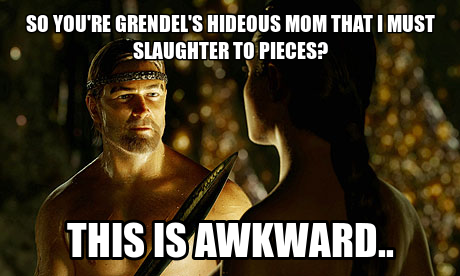
I have to say I expected the story to end after Beowulf defeated Grendel's mother - and isn't that, in and of itself, so interesting? Beowulf's toughest foe is a woman, a mother, who is avenging her son. It's such an interesting comment, and it can be taken (at least) two ways - on one hand, Grendel's mother is powerful and her vengeance has "legitimate" motivations; she's not killing for funsies or because some jocks were mean and loud and annoying. Beowulf killed her son and desecrated his body (although Grendel's mother is dead when that happens, but I digress). If you killed my son and chopped the head off his corpse, I'd be coming after you too.
On the other hand, Grendel's mother is a monster. Presumably this translates to her physical appearance - her unnatural strength and invulnerability is certainly abnormal. There's a weird interplay and conflict between the ideals of femininity and monstrosity, where Grendel's mother's, well... motherhood is her most feminine trait, and is contrasted with her physical strength, bloodlust, and desire for vengeance, all of which are/were considered traditionally unfeminine. So the sharp divide between what actions are/were considered acceptable for women to perform and what Grendel's mother actually does would certainly make her a monster to the Scyldings and Geats (she falls on the "wrong" side of the line); to us, I think, she's a little more understandable.
(There's also the unspoken question of how her Cain-ancestry inherently damns her, but we won't talk about that now.)
What's also interesting is how the idea of vengeance is gendered in Beowulf. Beowulf himself is fighting on Hrothgar's behalf; he's obtaining Hrothgar's vengeance for him - but something that struck me was how Beowulf's hatred of Grendel also felt strangely personal. I feel like there's this subtextual idea that Beowulf's vengeance is somehow more legitimate, or more acceptable, than Grendel's mother's - whether it's because he's doing it on behalf of someone else (but is he?) makes it inherently unselfish, or if it's because he's a man fighting a monster, I'm not sure. Is the vengeance of Grendel's mother considered more monstrous, or less legitimate, because she is a woman? Does her revenge make her monstrous, or does her monstrosity make her vengeful? Could it be both?
The last point I want to bring up are the parallels I saw between Grendel and Grendel's mother in Beowulf, and Caliban and Sycorax in The Tempest. Despite the audience never seeing Sycorax, her influence in the play is pervasive, and she and her son are both considered monsters by Prospero, who I consider (loosely and without much basis) roughly analogous to Beowulf. Beowulf is an old story, and it has many archetypal traits that have filtered down through the ages, to Shakespeare's time and beyond.
Showing posts with label Grendel's Mother. Show all posts
Showing posts with label Grendel's Mother. Show all posts
Monday, October 24, 2016

Saturday, October 22, 2016
Grendel's mother is on the warpath!
“Heaven has no rage like love to hatred turned / Nor hell a
fury like a woman scorned.”
- William
Congreve
This may not be the most popular opinion, but I feel a bit sorry for Grendel's mother. Not only has she been condemned to a life of solitude
and misery because of the wrongdoings of her ancestors but now her son has been
killed. Granted Grendel wasn't a complete
angel, but as Sarah mentioned in class, the men he murdered were also murderers
so it's a bit of a gray area.

I am not yet a mother but I can only imagine the anguish and
fury Grendel's mother would feel at the loss of her son. The need for revenge
would be immense in time of sorrow and rage. I'm not condoning her killing
everyone in her anguish, but I can see how the loss she feels could lead to
those thoughts. But honestly, can you really
blame her? The very men who are free of curses in their favor from God and get to live their lives freely have killed her son,
her only companion. Of all the punishments she has endured, thanks to Cain, this
is the proverbial straw that broke the camel's back. Even the king recognizes why she attacked his
men when he explains, “She avenged that feud / in which you killed Grendel...a
mighty evil marauder who means to avenger / her kin...” (Liuzza 135, 1334-1340).
Furthermore, it's really a cycle of revenge that is
occurring: Cain kills Abel, God avenges his death by banishing his kin, Grendel avenges his banishment by killing
God’s merry men, Beowulf avenges the death of the men by killing Grendel, Grendel’s mother avenges his death by killing
the king's counsel and then Beowulf is called upon to avenge that death by killing Grendel’s
mother. While receiving instructions
from the king, Beowulf exclaims, “Sorrow not, wise one! It is always better / to avenge one’s friend
than to mourn overmuch” (Liuzza 138-139, 1384-1385). If this is what is expected during this
time period, perhaps Grendel's mother is simply living up to societal expectations in her bloodthirsty quest. Thoughts?
Sources:
1. http://www.dailywritingtips.com/16-misquoted-quotations/
2. http://www.imdb.com/title/tt0442933/mediaviewer/rm2676857088
3. https://movinglightreviews.wordpress.com/tag/beowulf/
4. Liuzza, R. M. Beowulf. 2nd ed. Buffalo: Broadview, 2013. Print.
4. Liuzza, R. M. Beowulf. 2nd ed. Buffalo: Broadview, 2013. Print.
Subscribe to:
Posts (Atom)