Showing posts with label Alyssa Denikos. Show all posts

Sunday, December 4, 2016

Are People Inherently Good?

Although I was confused at the start of this comic, after clearing things up a little in class, I was able to come back and read the rest of it in a new light. And I have to say, it was pretty cool. I even liked the dual narration by the end of it; the juxtaposition of Daredevil's and Punisher's mindsets showed me which character I empathized with more. And honestly, that was the weirdest thing about this comic for me... I really found myself agreeing with the Punisher more than Daredevil.

Needless to say, we are inclined to think that morally, it is not right to kill another person. Even though that is how the Punisher decided to fight crime, I think that his arguments were much more realistic and practical than Daredevil’s. Sure, in a perfect world, Daredevil’s ideas could come to light. If you just rough someone up a bit, make sure they suffer a little for what they did, maybe they will realize the error of their ways and decide to change. However, that’s honestly not at all the way people work. 

It’s really hard for people to change; they have to really want to. You can’t force someone to change the way they think and the way they live their lives. It’s nice to think that people are inherently good… but are they? In the comic, I feel like this question is highlighted a lot… and the answer is arguably not on Daredevil’s side. For instance, a lot of the plots that Jackal and his henchmen formulated could not have gone on without the paid help of others. Save for the woman visiting her husband in jail who clearly did not know she was part of any plot – a lot of these regular “inherently good” citizens were willing to tell lies for money. I’m sure they didn’t think of the implications of their lies… but still. Is lying for money an inherently good thing…? I would think not.

Additionally, the Punisher was the only one getting any results. At the end of the comic, we hear from Mary’s letter that crime had skyrocketed after the Punisher was put in jail. Obviously, crime goes down if there are less criminals around… However, I think that it’s possible some criminals “came out of hiding” once they heard the Punisher was in jail. Sure, that’s a lot of speculation… but if I were a criminal and knew there was a random guy around that would not just put me in jail, but kill me at any moment, I might decide not to commit a crime. Take away that extra fear and of course, crime would increase.
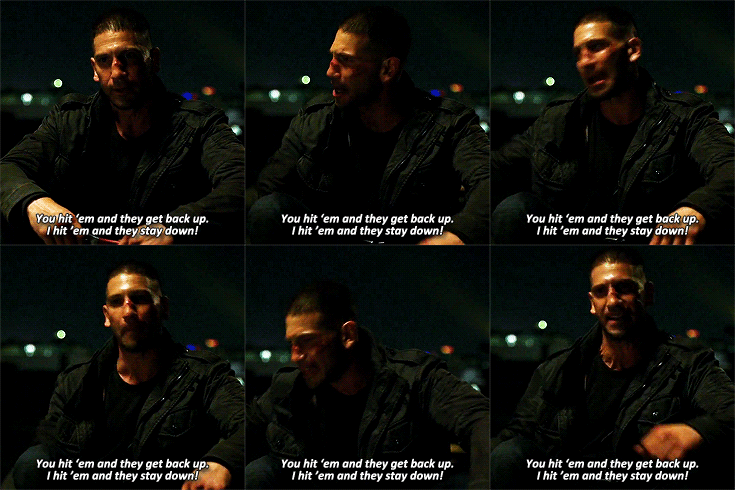


I don’t know… I mean, I’m honestly still not 100% convinced and on Punisher’s side. But really… is punching a murderer in the eye and throwing him in jail going to make him change? I really don’t think so. I mean, look at the Punisher. At the end of the comic, he had been beaten up by Daredevil and put in jail. I don’t know about you guys, but I don’t take him saying that “this time, there will be no compromises. No mercy. This time, I’ll get it right” (page 148) to mean he’s learned anything.

Monday, November 14, 2016

Sneaking Cookies

My familiarity with The Strange Case of Dr. Jekyll and Mr. Hyde before reading it today began and ended with hearing of the title. As such, I actually had no idea that the story had to do with a split personality disorder until towards the end of the novel. But, I’m kind of glad that I had no background knowledge of Dr. Jekyll and Mr. Hyde, because going into the novel without knowing much about it allowed me to “get into it” more. I read the whole thing through without putting it down and thought it was interesting, although the language was admittedly a little difficult at some parts.

Dr. Jekyll and Mr. Hyde displays the struggle between our inner monsters and our inner heroes. We all like to declare ourselves “good people” or even heroes, as displayed through Dr. Jekyll, the upstanding (literally, and figuratively) older doctor with lots of friends; but we also have a desire to get in touch with our monstrous sides, as displayed through Mr. Hyde, the evil young man. Of course, most people without split personality disorder do not experience this to the extent as the character in the novel does, but we all have experienced this to some degree.

Think about even the most insignificant time it has happened to you… Your parents tell you not to eat a snack when you get home from school because you’ll ruin your appetite. But still, when they leave the room, you sneak a cookie. You know it’s wrong, but you still want the cookie. It’s interesting that this phenomenon occurs. We all know some things that we do are considered wrong, but we still do them. Of course, killing a bunch of innocent people is a lot more wrong than sneaking a cookie, but still. Why do we do these things, knowing they are wrong? We want to be good, but are people inherently bad?


The fact that I didn’t realize that Jekyll and Hyde were actually the same person I think adds to the novel’s motif of the struggle between inner good and evil. I personally am always inclined to see people as either good or evil, especially in works of fiction. However, as we are discovering in the many works we have read/watched in this class, people can, and do, have both monstrous and heroic qualities.


Another interesting point raised by the novel is regarding the age difference between Dr. Jekyll and Mr. Hyde. Dr. Jekyll looked/was older than Mr. Hyde. Does this mean that the author is suggesting that older people with more experience are “better” people, while younger people are more inclined to be monstrous? Although some may argue that this could be true, I think that people can be monstrous regardless of age. 

Overall, I enjoyed the read and thought the novel raised some very interesting points.

Monday, October 31, 2016

Imaginary Monsters or Real-Life Issues?

In Asma’s “Monsters and the Moral Imagination, Asma argues against current “liberal” theory on monsters, which holds that monsters are dramatized and then used to “scold ourselves and our intolerant society for alienating the outcast [the monsters] in the first place” (2) and will likely disappear once we “embrace the difference[s]” (5) of the outcasts. Instead, Asma explains that “the monster concept is still extremely useful” and can “virtually represent the obstacles that real life will surely send our way” (5). Asma’s argument that the concept of monster is still relevant in today’s society is interesting, although I am not sure I agree with him.

First off, it seems like Asma’s argument is not supported by the examples he gives. Although he does list some stories of monsters – like Frankenstein for example – that’s just it: he simply lists these stories with no analysis of how they represent real-life obstacles. Instead, the majority of Asma’s support in the article consists of real-life anecdote. The anecdote of Bruce Shapiro, for example, was a real-life scenario in which real-life people were put into a terrifying situation in which they feared for their lives. The same thing goes for his anecdote of Malim Abdul Habib. Again, a scary situation featuring a monstrous group of attackers that actually happened.

My point is this: why do we need “virtual representations of real-life obstacles” when real life gives us those obstacles point-blank? Don’t get me wrong, I love fantastical stories as much as the next person does, but as far as all of them representing many different real-life obstacles like 9/11 or the economy, Asma does not have me sold. How can “monster stories” which are so similar that they can even be grouped into a category called “monster stories” (5) all represent different conflicts? Especially when, as Asma states himself, these stories focus on the “hero phase,” and not the “threat phase” (5).


I think that the term “monster” is still very relevant in today’s society. People definitely still act monstrous and create real-life issues from those monstrous actions. However, I am unsure whether or not monsters in recent literature and media represent current real-life issues. For example, what issue does Edward from “The Twilight Saga” (1) represent…? He is a vampire, after all. Obviously, that is an extreme example, but still, even the author himself mentioned Twilight. I think that in general, and in older literature, monsters can represent real-life issues, especially general societal issues; and that monsters can take on the worst qualities found in real-life people. But I am not so sure that in recent literature monsters represent obstacles found in daily life.