Showing posts with label Beowulf. Show all posts

Tuesday, October 25, 2016

Beowulf and Revelation

After reading Beowulf for a second time, I began seeing similarities between Beowulf and apocalyptic biblical literature. The story of Beowulf is rich with Christian subtext as seen through the backstory of Grendel's lineage. Apart from Beowulf resembling a messianic figure in the story, he also resembles Archangel Michael from the Book of Revelation.

http://67.media.tumblr.com/tumblr_l7i7esa09K1qcr6iqo1_1280.jpg
http://67.media.tumblr.com/tumblr_l7i7esa09K1qcr6iqo1_1280.jpgn

Revelation 12:7 - 12:9 (KJV)

7 And there was war in heaven: Michael and his angels fought against the dragon; and the dragon fought and his angels.
8 And prevailed not; neither was their place found any more in heaven.
9 And the great dragon was cast out, that old serpent, called the Devil, and Satan, which decieveth the whole world: he was cast out into the earth, and his angels were cast out with him.


Both are righteous warriors fighting against the forces of evil. Beowulf even fights against a dragon for his final battle. I think this represents Beowulf fighting against Lucifer himself, but what about the other two monsters Beowulf faces? Do they resemble other evil biblical characters who would side with the Dragon?

There are many parallels between Grendel and Cain. The story explains that Grendel's monstrosity was due to his relation to Cain, the original murderer. Apart from the direct connection between the two established in the story, both Grendel and Cain killed out of jealousy. Having his offering rejected by God, Cain murders his brother Abel, who was favored by God, out of spite. In the same vein, Grendel kills the Danish warriors in their sleep for enjoying luxuries he was cursed to live without. I think this is used to represent Beowulf vanquishing Cain and his lineage, who would be fighting against God in the final battle.

http://vignette2.wikia.nocookie.net/biblestudy/images/0/02/Cain-Abel.jpg/revision/latest?cb=20160716193740

Grendel's mother could be said to also represent Cain's lineage, but I think she has many similarities with a less known apocryphal character from Judaeo-Christian tradition. Grendel's mother parallels Lilith, a figure in Jewish biblical mythology who is said to be Adam's original wife.

http://www.supernaturalwiki.com/images/thumb/1/1e/Lilith-JohnCollier.jpg/150px-Lilith-JohnCollier.jpg

According to the myth, God created man and woman at the same time during Creation. God wanted Lilith to be subservient to man, but she refused and, as a result, was exiled from the Garden of Eden. The creation story then proceed as usual, having Eve created from the rib of Adam. The character of Lilith is portrayed as a demonic female which is fairly similar to the depiction of Grendel's mother. One telling of Lilith's story has her bearing a child with Adam prior to her departure from the Garden. This child was Cain.

It would be very interesting to see how other mythologies, especially Scandinavian mythology, influenced Beowulf as each has its own portrayal of the battle between good and evil.
 

Monday, October 24, 2016

Monsters All, Are We Not? Grendel, Grendel's Mother, and Caliban

So, now we're two-thirds of the way through Beowulf, and I'm not quite sure how I'm feeling? A little...  off, I guess? Unlike a lot of people in this class, this is my first time reading Beowulf, so now I have a taste of the confusion people have been feeling for the past few weeks. 

I have to say I expected the story to end after Beowulf defeated Grendel's mother - and isn't that, in and of itself, so interesting? Beowulf's toughest foe is a woman, a mother, who is avenging her son. It's such an interesting comment, and it can be taken (at least) two ways - on one hand, Grendel's mother is powerful and her vengeance has "legitimate" motivations; she's not killing for funsies or because some jocks were mean and loud and annoying. Beowulf killed her son and desecrated his body (although Grendel's mother is dead when that happens, but I digress). If you killed my son and chopped the head off his corpse, I'd be coming after you too. 

On the other hand, Grendel's mother is a monster. Presumably this translates to her physical appearance - her unnatural strength and invulnerability is certainly abnormal. There's a weird interplay and conflict between the ideals of femininity and monstrosity, where Grendel's mother's, well... motherhood is her most feminine trait, and is contrasted with her physical strength, bloodlust, and desire for vengeance, all of which are/were considered traditionally unfeminine. So the sharp divide between what actions are/were considered acceptable for women to perform and what Grendel's mother actually does would certainly make her a monster to the Scyldings and Geats (she falls on the "wrong" side of the line); to us, I think, she's a little more understandable. 

(There's also the unspoken question of how her Cain-ancestry inherently damns her, but we won't talk about that now.)

What's also interesting is how the idea of vengeance is gendered in Beowulf. Beowulf himself is fighting on Hrothgar's behalf; he's obtaining Hrothgar's vengeance for him - but something that struck me was how Beowulf's hatred of Grendel also felt strangely personal. I feel like there's this subtextual idea that Beowulf's vengeance is somehow more legitimate, or more acceptable, than Grendel's mother's - whether it's because he's doing it on behalf of someone else (but is he?) makes it inherently unselfish, or if it's because he's a man fighting a monster, I'm not sure. Is the vengeance of Grendel's mother considered more monstrous, or less legitimate, because she is a woman? Does her revenge make her monstrous, or does her monstrosity make her vengeful? Could it be both? 

The last point I want to bring up are the parallels I saw between Grendel and Grendel's mother in Beowulf, and Caliban and Sycorax in The Tempest. Despite the audience never seeing Sycorax, her influence in the play is pervasive, and she and her son are both considered monsters by Prospero, who I consider (loosely and without much basis) roughly analogous to Beowulf. Beowulf is an old story, and it has many archetypal traits that have filtered down through the ages, to Shakespeare's time and beyond. 

Old Tales Examined with Modern Eyes

At this point, I've gone over Beowulf so many times that I am fairly certain I could write a dissertation on it (not really - please don't quote me on that).  Since the presentation given last week by Rafael, Alyssa, and myself touched upon the major themes present in Beowulf's first and second battles, I don't really know if I have it in me to examine the events again in great detail.  Instead, I want to look at the most important characters we've been introduced to at this point, and their motivations.

Starting with Beowulf: he's a warrior, he craves battle, and is the hero of the story.  There isn't much else to say, other than I find myself wanting more depth to the character.  Perhaps it's because I've seen so many "good versus evil" stories that feature heroes that have some form of character development beyond "See that monster? I'm going to kill it. Hrothgar, hold my beer." that I find myself almost wishing for Beowulf to experience some form of defeat or hardship so that he can grow as a character, other than being the generic, undefeated hero that has been seen in hundreds of stories throughout the ages.  Granted, this story is thousands of years old and is the original "epic", so the concept of character development was not around when it was created.  However, I find it difficult to relate to Beowulf beyond him being the "good guy" and thus worthy of our support.

Grendel, while still falling victim to the same simplicity that plagues Beowulf, nevertheless develop a little bit more than Beowulf does, and at the very least, one can understand his motivations and sympathize with them.  For example, Grendel's main point of rage is the noise and festivities that constantly stem from Hrothgar's mead hall.  While he goes a little overboard in his desire to eat the partygoers, I can still sympathize with him in the fact that I'd be upset if someone didn't stop partying into the wee hours of the night.  His motivations may be simple, of course, but I feel as if they're a bit more relatable than Beowulf's.  Please note that I do not condone the eating of partygoers.  Grendel's mother is in the same vein.  A desire to protect her child and to promote his wellbeing (and then the pain of seeing him with his arm ripped off) gives her a better level of character depth than what one would see from Beowulf.

As said before, I am not trying to be overly critical of Beowulf.  I fully acknowledge the impact the story had on English literature and the fact that it's the foundation for hundreds of more advanced stories to come.  However, I am saying that because we've gotten to the point in society where we want more depth to our characters, I find it a bit difficult to appreciate the vanilla archetypes presented in Beowulf.

Beowulf Revisited Half a Decade Later

My first and last encounter with Beowulf and Grendel was in my sophomore or junior year of high school. I remember enjoying the classic English epic poem, and appreciating the analysis and snark from John Gardener's take on the legend. Coming back to the text years later, I was unsure of what to expect. Could Beowulf hold up to my existing memories of it?

Not really, no.

Several issues rose up during my return to Beowulf. First, the poem was far more flowery and descriptive than I remembered. Prose can be beautiful if pulled off subtly and with enough skill, but Beowulf's overly-long descriptions drain any enthusiasm I have for getting the scene established. Not helping is the fact that I already knew of every twist and turn the story would take. I had avoided getting the book spoiled prior to my first reading of it. Today, though, I saw everything coming and plodded along.

The greatest problem I have with revisiting Beowulf is that there is little to no room for speculation and analysis. The way the story is written gives the characters very basic motivations for their actions. Unless you really stretch the material, you cannot theorize on much the story has to offer.

Because of the last issue in particular, this blog post will be shorter than usual. I still look back on the poem fondly, though. It has its merits, and should still be taught in English classes.

Side note - somehow, I still remember some parts of the comedy version of Beowulf my high school English teacher gave my class for April Fool's. Beowulf made a string of hand-related puns after defeating Grendel, called Unferth a poser, and was oddly specific on how many men he would take to assist the Danes.

Sunday, October 23, 2016

Avenge or Revenge, is either Okay?

In this portion of Beowulf that we read, Grendal's mother wanted to seek avenge for Grendel's death. as Stephanie mentioned in her post-being a mother of someone who was murdered would probably cause you to be pretty upset and angry. This being said, it would make sense that Grendal's mother wished Beowulf dead. But is avenge the right answer?

What is the difference between avenge and revenge? According to Merriam-Webster Dictionary, to avenge is to "harm or punish someone who has harmed you or someone or something that you care about" while seeking revenge is defined as, "to avenge (as oneself) usually by retaliating in kind or degree, or to inflict injury in return For." So, there doesn't seem to be much of a difference between these two definitions. Regardless of whether or not Grendal's mother wanted to seek avenge or revenge, is either okay?

Maybe some of you would disagree with me, but I don't understand how killing Beowulf would help Grendal's mother. Killing Beowulf wouldn't bring Grendal back to life. Nothing Grendal's mother did to Beowulf could change the fact that her son is dead. While grief is a process and I don't expect Grendal's mother to suddenly feel better that her son was murdered, I don't see anything good coming out of trying to kill Beowulf.

I will say however, I kind of feel bad for Grendal and his mother. As we mentioned in class, there isn't really much in the poem explaining the appearance of Grendal or his mother that would make you think they are monsters. While your family members may give insight to who you are, they do not define you. With this in mind, even though Grendal was killed and thought of as a monster, his mother doesn't have to be seen this way. Rather than trying to kill Beowulf she may actually be able to receive some sympathy from people because her son was murdered. Instead, her evil intentions get the best of her.

Saturday, October 22, 2016

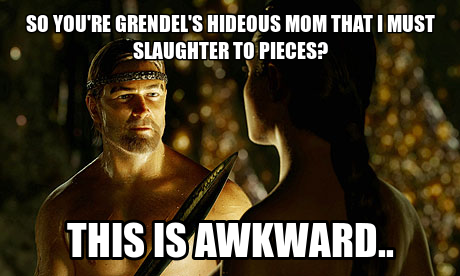
Grendel's mother is on the warpath!

“Heaven has no rage like love to hatred turned / Nor hell a fury like a woman scorned.” 
  - William Congreve

This may not be the most popular opinion, but I feel a bit sorry for Grendel's mother. Not only has she been condemned to a life of solitude and misery because of the wrongdoings of her ancestors but now her son has been killed.  Granted Grendel wasn't a complete angel, but as Sarah mentioned in class, the men he murdered were also murderers so it's a bit of a gray area.


I am not yet a mother but I can only imagine the anguish and fury Grendel's mother would feel at the loss of her son. The need for revenge would be immense in time of sorrow and rage. I'm not condoning her killing everyone in her anguish, but I can see how the loss she feels could lead to those thoughts.  But honestly, can you really blame her?  The very men who are free of curses in their favor from God and get to live their lives freely have killed her son, her only companion. Of all the punishments she has endured, thanks to Cain, this is the proverbial straw that broke the camel's back.  Even the king recognizes why she attacked his men when he explains, “She avenged that feud / in which you killed Grendel...a mighty evil marauder who means to avenger / her kin...” (Liuzza 135, 1334-1340).

Furthermore, it's really a cycle of revenge that is occurring: Cain kills Abel, God avenges his death by banishing his kin, Grendel avenges his banishment by killing God’s merry men, Beowulf avenges the death of the men by killing Grendel, Grendel’s mother avenges his death by killing the king's counsel and then Beowulf is called upon to avenge that death by killing Grendel’s mother.  While receiving instructions from the king, Beowulf exclaims, “Sorrow not, wise one!  It is always better / to avenge one’s friend than to mourn overmuch” (Liuzza 138-139, 1384-1385).  If this is what is expected during this time period, perhaps Grendel's mother is simply living up to societal expectations in her bloodthirsty quest.  Thoughts?


Sources:
1. http://www.dailywritingtips.com/16-misquoted-quotations/
2. http://www.imdb.com/title/tt0442933/mediaviewer/rm2676857088
3. https://movinglightreviews.wordpress.com/tag/beowulf/
4. Liuzza, R. M. Beowulf. 2nd ed. Buffalo: Broadview, 2013. Print.