Showing posts with label X2. Show all posts

Tuesday, September 6, 2016

The Moral High Ground

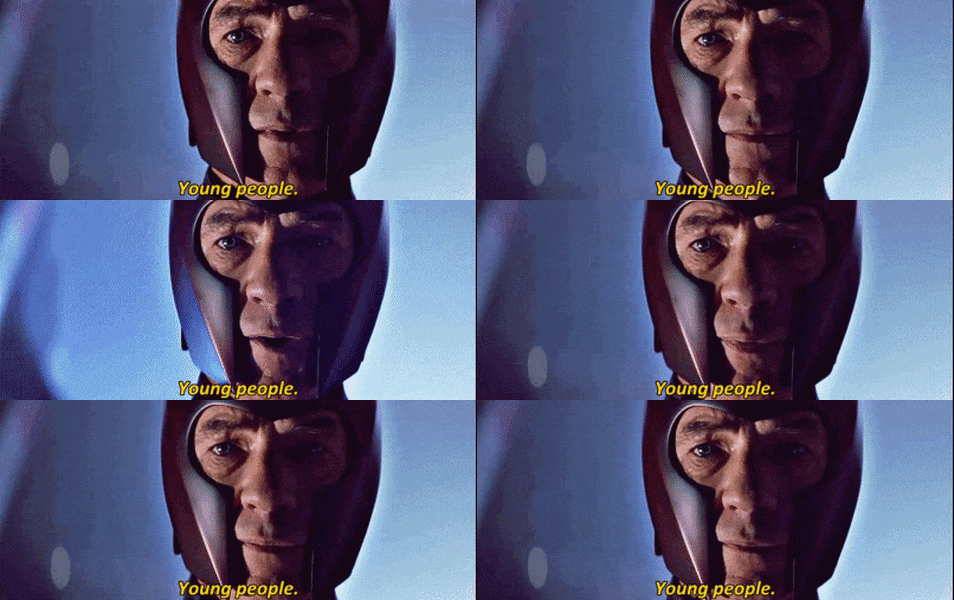
I would like to look back at the scene from X-men, where, during the kidnapping of Rogue from the train station, Charles Xavier holds Magneto at his mercy. Knowing Charles as well as he does, Magneto calls his bluff by holding the surrounding police force hostage. Thus, Charles is left with two choices: release Magneto, or kill him.


Now, at this point we’re fairly familiar with Magneto as a character. Experiencing the Holocaust as a child defined his life, and he’s very paranoid when it comes to seeing the worst in a government. As such, he easily jumps to the extreme in the grand debate of Mutants vs. Humans, and seems willing to do anything to “save” the mutants from the humans in power. In the case of the movie, this is evidenced by his decision to sacrifice a teenaged girl in cold blood to further his plot.
Additionally, in X-2, we see that Magneto is willing to escalate when he orders a brain-washed Charles to kill all of the humans. In a word, Magneto is genocidal. Therefore, the question remains: Should Charles have killed Magneto when he had the chance? More than that, how does the decision to not kill affect Charles as a hero figure? Should heroes be willing to kill their monsters – to kill one to save a hundred? Well, I’ll let you answer that. Although, during the assault on the school in X-2, Wolverine seems to think so.

That being said, I feel this question is a little harder to find an answer for within the context of X-men. After all, Charles and Magneto were once fast friends, and it’s also a matter of discrimination – which could make either choice justifiable. In X-men, I feel the line is blurred a bit more than it needs to be. So I now ask the same question in a different context: Batman vs. The Joker.


It is safe to say that The Joker is – in all of the DC continuities I can think of off the top of my head – an omnicidal maniac, who will do whatever he can to rile up Batman. The Joker possesses few, if any, redeeming qualities. Meanwhile, Batman “never” kills – he very rarely does, but let’s ignore that for now – because it’s against his moral fiber. Therefore, taking our definitions and discussions of what a hero is, should a hero be willing to kill in what is clearly the defense of others? How does making such a decision affect their being a hero in our eyes?

Personally, I’m of the opinion that a hero should – which is not to say that they should go on killing sprees – because a situation sometimes calls for it. For such an example, I jump back to Batman vs. The Joker. I feel like Gotham would be a much saner and safer place without The Clown Prince of Crime. But I am also of two minds when it comes to answering this question, because it does make me question Batman’s integrity as a hero. He’s already a frightening vigilante, and being willing to take that extra step would make him even easier to fear.

Sources:

X-Men. Dir. Bryan Singer. 20th Century Fox, 2000. DVD.

X2. Dir. Bryan Singer. 20th Century Fox, 2003. DVD.

Monday, September 5, 2016

Will Evolution Help Us, or Hurt Us?

X-Men and X2 are two excellent displays of how characters, and thus people, can be both heroes and monsters. In many movies, there is a clear hero who the audience is supposed to root for, and a clear monster or villain who the audience is supposed to be against. But in reality, and in these two X-Men movies, people are not so cut and dry. You must figure out characters’ or peoples’ motives; you don’t simply judge them based on appearances.

In the X-Men movies, the main characters are what we would consider “monsters” in the most general sense: some mutants are quite frightening in appearance, and all of them have powers which, if used appropriately (or inappropriately) could frighten and hurt non-mutants.


However, we discover that, at least for the X-Men, scaring and hurting is not their intention. In fact, most mutants just want to be accepted by society. Thus, simply by the appearance and characteristics of mutants, the X-Men movies blur the lines between hero and monster.

Additionally, the X-Men movies make the difference between hero and monster difficult to discern through the intentions of characters. In the first movie, the X-Men, Magneto is essentially the “villain.” He seeks to achieve mutant superiority by turning non-mutants into mutants. He turns Senator Robert Kelly, a senator who tries to pass a mutant registration act, into a mutant. At first glance, this may seem to be an evil and monstrous thing to do: turn someone into a mutant when they are not. However, when he was younger, Magneto, as Erik, was separated from his parents as he enters a concentration camp. Although Magneto’s actions might seem uncalled for, when you realize that his intentions are based off of growing up in a world where people had to register themselves for simply being Jewish, it makes sense why Magneto would want to avoid the same thing just because he is a mutant.  


A final way the X-Men movies blur the lines is through the use of characters. Although Magneto is a villain in the first movie, in X2 he joins the X-Men as they fight a human villain who seeks to destroy all mutants. Even though Magneto and his followers still want different things than the X-Men, we see a side of them that we did not get to see in the first movie: that he can stand for a cause which we can all relate to.


However, I thought the most interesting aspect of the X-Men movies was the emphasis on evolution, and the reality factor it conveyed. As a Biology major, I really honed in on this aspect of the movies. It certainly makes me think, because one day, the human species will mutate and will evolve. This is true because it has happened in the past: before us, there were apes. It makes me wonder whether or not people would exile those who were different, if those exiled beings would fight back like Magneto, or if they would just want equality like the X-Men.

The Origin of Magneto

In most forms of media regarding heroes and villains, origin stories of characters help to provide context and background. For people either watching or reading about the character, the origin story gives a glimpse into the reasons for the mission and actions that a character undertakes. In regards to the former X-Man and member of the Brotherhood of Mutants Magneto, the chilling images from the opening scene of the first X-Men movie reveals the heartbreaking events that created the anti hero. Without this context, the audience could not formulate a complete rendering of Magneto the individual. As a result of his origin story, Magneto becomes a more well-rounded character, enabling individuals to create a sense of understanding for the often misunderstood mutant.
At first glance, Magneto seems to be the one of the main antagonists of the X-Men storyline. However, as the first scene of the 2000 film X-Men shows, Magneto is not only a mutant, but also an individual of Jewish descent, suffering through the events of the Holocaust during the Second World War. This pivotal scene depicts the selection process at Auschwitz and continues to remain as an enduring image to the opening of the X-Men saga. A young Magneto discovers his mutant powers as a result of the traumatic moment involving the separation from his parents (X-Men). Certainly, such an experience would have a lasting effect on the psyche of the young boy, breeding traits of resiliency, self-reliance, and a desire for safety and control within himself.
For the second time in his life, due to his differences, Magneto has been designated as an outsider, someone who is feared, suppressed, and exploited. Sadly, Magneto lost his family in the events of the Holocaust and witnessed firsthand the lengths that humans will go in order to control perceived enemies. As Magneto himself states in the film X-Men, “Mankind has always feared what it doesn’t understand” (X-Men). Having seen the destruction and sorrow which mankind can enforce on minorities without power, one can empathize with Magneto’s approach to defend and protect his mutant family by any means necessary.
This context helps one to comprehend his actions in the movies X-Men and X2 when he attempts to thwart the Mutant Registration Act as well as join the X-Men in defeating Stryker (X-Men, X2). Interestingly, Magneto does not even view himself as the “bad guy” in the story. In X2, Magneto questions, “Is that what they call me?” when told by fellow mutant Pyro that he is referred to as such (X2). Despite the fact that some would consider him to be a monster, Magneto purely does whatever he feels is needed in order to save his mutant family from the fearful humans. Although one does not have to agree with his actions or methods, Magneto’s backstory aids in humanizing his character and establishing an explanation for his ruthless and often uncanny approach to mutant-human relations.

Sources:

X-Men. Dir. Bryan Singer. By David Hayter. 20th Century Fox, 2000. DVD.

X2. Dir. Bryan Singer. By Bryan Singer. 20th Century Fox, 2003. DVD.

I pledge that I have neither given nor received any unauthorized aid on this assignment. Anthony King