Showing posts with label Stephanie Kesner. Show all posts

Saturday, November 26, 2016

Are Humans Scarier Than Zombies?

Look around you.  Our society is in a current state of upheaval.  Every day there is a new story in the media about protests turned into riots turned into destruction and looting, or a new victim of police brutality, or another officer ambushed and killed, or a murder-suicide.   Seeing the violence and aggression happening in the world today I can't help but to agree with Bishop’s point that, “...Kirkman’s The Walking Dead comic series, sheds a harsh light upon the potential devolution of humanity - that we have become chaotic creatures of selfishness, violence, and unchecked aggression who do more damage to ourselves and the world around us than any reanimated corpse ever could” (74).  Terrorism is still a real threat, neighborhoods and communities aren't as safe as they used to be, and we are so quick to spew hateful words that we forgot what it means to be kind and to look out for one another.

It's a harsh reality and I often wonder how we got here.  We are no longer in a hunter-gatherer society where survival is our first and often only instinct yet we are still in kill or be killed mode.  Is it the media perpetuating violence?  Is it the shows we are watching?  Have we become so focused on ourselves that we are blinded to the plights of others?  When we see those in need do we help or do we look away?  There is so much hate in the world right now; so much aggression and close-mindedness that it becomes hard to see the light at the end of the tunnel.

But the question is, how do we go back?  Do we really want to be a worse nightmare than zombies?  How sad is that?!  How do we restore a sense of community, unity, and respect for one another?  We don't have to agree with each other to listen and understand.  We all have such unique experiences and perspectives. We come from different backgrounds, different cultures, and different religions.  There is plenty of hate in our history without us adding more to it.  We may not be up against a zombie apocalypse, but we still have very real threats and so far we are not handling them well.  I don't know for sure how to fix it and it may seem like childish ideals but I believe we can become a race of respect and empathy.  It may take a while but if each person commits to a new way of thinking I believe it could happen… 


Well... this blog got a little heavy, so to lighten it up a bit, here’s a "zombie" scene from the movie Stepbrothers:


Sources:
1. Bishop, Kyle W. “Battling Monsters and Becoming Monstrous: Human Devolution in The Walking Dead." Ed. Marina Levina and Diem-My T. Bui. Monster Culture in the 21st Century: A Reader. New York: Bloomsbury Academic, an Imprint of Bloomsbury Plc, 2013. 73-85. Print.
2. https://www.youtube.com/watch?v=r6hOMKQTC7w

Thursday, November 3, 2016

Is it the deed or the effect?

“I, not in deed, but in effect, was the true murderer.” 
- Victor Frankenstein

This is an intriguing line in that it presses upon the fact that to be considered a monster may not lie only in the deed that is done but in the actions that lead to monstrous deeds.  Victor did not kill William nor Justine and yet his obsession in his work led to the creation of his monster and his inability to acknowledge, control and destroy said monster led to monstrous deeds and lives lost.


How does this change the way we look at monsters?  I think it expands the notion of monsters from acts only to acts and lack of actions.  If Victor had destroyed what he created, or at least notified someone that a creature was on the loose, there wouldn't be a metaphorical trail of blood leading back to him. 

Not only are we responsible and should be held accountable for the deeds we do, but perhaps we should also be held accountable for the deeds we don't do but greatly influence, as well as the acts we don't prevent when we are capable to do so.  I'm not saying that in situations such as a random knife attack we are held accountable to stop the attack.  I'm merely saying that there are moments when we do something questionable and we try hard to justify our actions in an attempt to assuage our guilt; and in those very moments we need to really think about if we are on the path of monster-like deeds as a result of inaction.


Yes, there is a difference between monsters, monstrous acts, and acts that lead to monstrous outcomes but how big is that difference and where does one end and the other begin?  It seems like a lot of gray area to me…

Sources:
1. Grimly, Gris and Mary Shelley. Gris Grimly's Frankenstein. N.p.: Balzer & Bray, 2015. Print.
2. http://thebookwars.ca/2014/03/gris-grimlys-frankenstein/
3. http://www.mememaker.net/meme/brace-ourselves-the-gray-area-is-coming/

Saturday, October 22, 2016

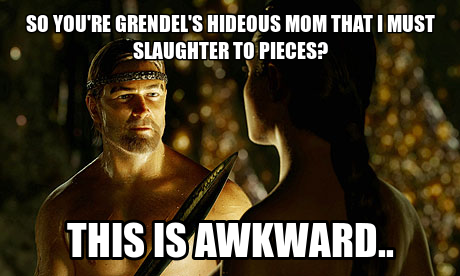
Grendel's mother is on the warpath!

“Heaven has no rage like love to hatred turned / Nor hell a fury like a woman scorned.” 
  - William Congreve

This may not be the most popular opinion, but I feel a bit sorry for Grendel's mother. Not only has she been condemned to a life of solitude and misery because of the wrongdoings of her ancestors but now her son has been killed.  Granted Grendel wasn't a complete angel, but as Sarah mentioned in class, the men he murdered were also murderers so it's a bit of a gray area.


I am not yet a mother but I can only imagine the anguish and fury Grendel's mother would feel at the loss of her son. The need for revenge would be immense in time of sorrow and rage. I'm not condoning her killing everyone in her anguish, but I can see how the loss she feels could lead to those thoughts.  But honestly, can you really blame her?  The very men who are free of curses in their favor from God and get to live their lives freely have killed her son, her only companion. Of all the punishments she has endured, thanks to Cain, this is the proverbial straw that broke the camel's back.  Even the king recognizes why she attacked his men when he explains, “She avenged that feud / in which you killed Grendel...a mighty evil marauder who means to avenger / her kin...” (Liuzza 135, 1334-1340).

Furthermore, it's really a cycle of revenge that is occurring: Cain kills Abel, God avenges his death by banishing his kin, Grendel avenges his banishment by killing God’s merry men, Beowulf avenges the death of the men by killing Grendel, Grendel’s mother avenges his death by killing the king's counsel and then Beowulf is called upon to avenge that death by killing Grendel’s mother.  While receiving instructions from the king, Beowulf exclaims, “Sorrow not, wise one!  It is always better / to avenge one’s friend than to mourn overmuch” (Liuzza 138-139, 1384-1385).  If this is what is expected during this time period, perhaps Grendel's mother is simply living up to societal expectations in her bloodthirsty quest.  Thoughts?


Sources:
1. http://www.dailywritingtips.com/16-misquoted-quotations/
2. http://www.imdb.com/title/tt0442933/mediaviewer/rm2676857088
3. https://movinglightreviews.wordpress.com/tag/beowulf/
4. Liuzza, R. M. Beowulf. 2nd ed. Buffalo: Broadview, 2013. Print.

Monday, September 26, 2016

The Robots Are Coming


What first struck me while reading Monstrous Technologies was the line in reference to our current societal state, “...a time in which humans are becoming increasingly intimate with technology, penetrated by and absorbed into the technological realm in an unprecedented manner” (Biles 148).  I believe this anthology was published in 2013 and since then technology has grown even more.  We use technology for a plethora of reasons: communication, connection, finances, planning, entertainment, and even dating, to name a few.

With all of our numerous uses of technology, it's no wonder we play with the idea of artificial intelligence and humanizing technology.  But the idea of robotic humans, or specifically Cylons as mentioned in the text, is terrifying.  We have no way of knowing how evolved these robots will become.  If science fiction movies (and Will Smith) have taught us anything it's that robots will likely try and overthrow humans.  The text even mentions the possibility of an “‘apocalypse’: a death of the imperfect human coincident with a technological resurrection” (Biles 149).  I don't know about you but I'd rather not tempt fate.  There’s even a notion that the human mind can essentially be uploaded to a computer.


Although I understand the importance of inquiry, exploration to further our minds and the human race, and the need to preserve our knowledge,  I have to wonder at what cost?  Do we really want to create technology that could eliminate us?  When should we draw the line and heed to the old adage of “curiousity killed the cat”?  The human mind and its constant quest for answers is too large of a fire to put out which means it's almost inevitable that soon we will be playing with humanized robot technology on a mass scale (that is if we haven't already).  The question remains, will we know when to stop and limit what we are producing?  Or will we continue in the name of science?  And if we do continue, how long before we start the process of eliminating the human race to advance technology?  Is our curiosity worth destroying our humanity?


Sources:
http://www.imdb.com/title/tt0343818/mediaviewer/rm1679789824

Levina, Marina, and Diem-My Bui T. "Chapter 9: Monstrous Technologies." Monster Culture in the 21st Century: A Reader. N.p.: n.p., n.d. N. pag. Print.
Chapter / Anthology


Sunday, September 11, 2016

Ack! Comics!

Let me start off by saying that except for reading a few Cathy comic strips found in newspapers when I was much younger, I am completely new to the world of comics.

http://msmagazine.com/blog/2010/08/12/cathy-to-utter-her-last-ack/

Reading McCloud’s Understanding Comics was an overwhelming experience.  I had never realized the complexity of comics or the amount of thought and work put into them. It is a lot to process and I found myself getting lost in his chapter of icons.  Did you know that there are different degrees of realism in simply drawing a face and that each degree of realism conveys a different connection and understanding to the material???  Neither did I!!!  Confusing right?!

Once I got through the initial barrage of pictures and words, the nuances of the art of comics started to become clear.  I was impressed by the amount of thought and detail that go into each page.  As explained in chapter three, the size of the box, the space or “gutter” between the boxes, and the shape of the boxes are all deliberate in conveying the artist’s message.  Who knew it was that complex?!  I merely thought boxes were used to separate each image so the reader wouldn't get confused.  I was also impressed by the mood that can be invoked with simple lines.  It is easy to convey emotions with words and you often get distracted by them, but to look closer at the drawings and feel the anger, sadness, or love coming from the artist is impressive.

I am a frequent watcher of the show The Big Bang Theory and for those unfamiliar with the show, most of the main characters are religious in their love of comic books.  A love that I had never fully understood.  However, I am beginning to understand why comics are so popular.  They are not merely images in little boxes with onomatopoeia splattered across.  Each stroke of the pen is deliberate. The degree of realism in the character versus the background is purposeful.  Whether a line is straight, curved, bold, or broken all have meaning in relation to the story and mood the artist is creating.  I don’t think I will look at comics the same.  I imagine there are varying degrees of comics and art within them but I am quite impressed with the field overall.  They truly are works of art.  Kudos to all the comic artists out there!

http://www.imdb.com/title/tt0898266/mediaviewer/rm3293874432


Additional Source:
McCloud, Scott. Understanding Comics:. New York: Harper Perennial, 1994.18. Print.