Showing posts with label Rafael Zamora. Show all posts

Monday, November 28, 2016

Attack of the Social Media Zombies

Although I do not find gore-filled depictions of zombie apocalypses particularly scary, the idea of turning into just another member of a zombie horde is unsettling. Being human involves being an individual and having some sort of agency over our own decisions. A zombie, on the other hand, merely obeys its base instinctual drive to consume and spread. Even a small scratch from an infected host could lead to your undying allegiance to the undead horde, and the odds of surviving a zombie apocalypse decrease as the size of plague grows. The only hope you have left is for time to take its toll on the rotting carcasses and decay their flesh from the bone.

http://i.imgur.com/ms6iWay.jpg
The tragic reality of living in a zombie infested world is that you must become like the zombies themselves in order to survive. In The Walking Dead, the lead protagonist, Rick, learns this through his struggle to keep his family and himself alive. Rick learns the dangers of interacting with both the living and the un-living, rationalizing his problematic decisions with the axiom, “you kill, you die”. As Rick begins to fully comprehend the state of his world, his view changes to “you kill, you live”. Rick is becoming a zombie himself, not through infection, but by aligning his core motives with that of the undead. His zombification will be complete when he begins to believe ‘you live to kill’. At that point, there is no turning back.

http://media.caglecartoons.com/media/cartoons/136/2016/07/11/181927_600.jpg


The parallels between zombie plagues and modern consumer culture are what I find truly terrifying. Commercial and ads are now constantly hiding away in our pockets. Aside from phones turning people into real world equivalents of zombies (ex. Pokemon Go zombie outbreak of 2016), phones provide a way of reinforcing mob behavior. Technology has allowed us to condense everything into a small package to be easily consumed through social media, and this ease of consumption is what makes social media addictive. Social media is built around virulent behavior through its use of likes, shares and retweets. A good example of virulent mob behavior produced by social media are ‘challenge videos’. This viral sensation causes the host to upload a video of themselves preforming a ‘challenge’, ranging from pouring ice water on their head to eating spoon-fulls of cinnamon for no apparent reason other than being part of the collective. The social media zombie functions similarly to the fiction zombie, obeying its base instinctual drive to consume and spread, but, in this case, consume and spread kitten videos, 'dank memes', and BuzzFeed articles.
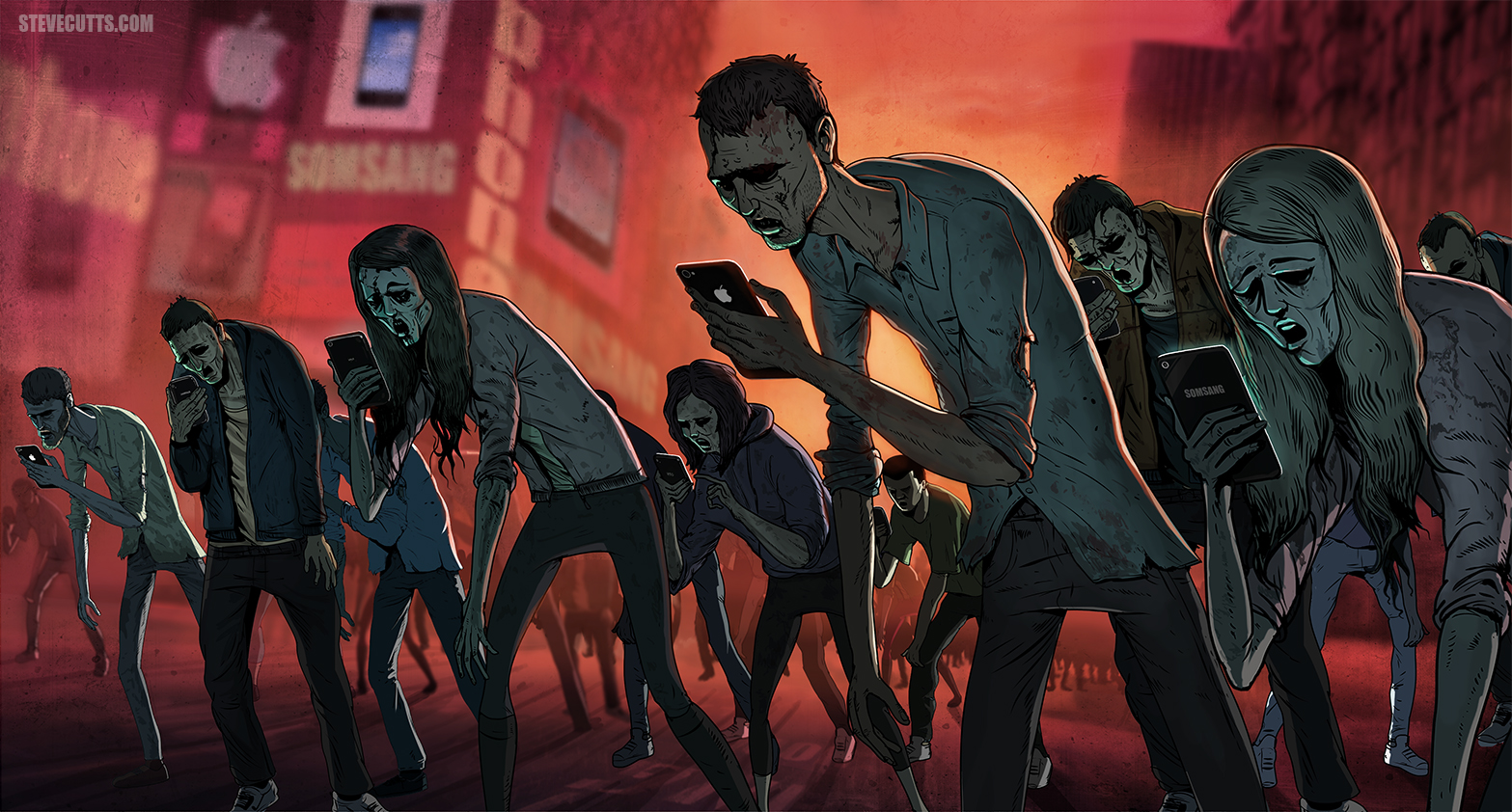
http://www.zerotoalpha.com/wp-content/uploads/2016/09/social_media_zombies.jpg
I believe our own society is reaching a point of no return, where our social media zombification will be complete. We are transitioning from ‘you consume, you live’ to ‘you live to consume’. Living without participating in social media is becoming more difficult. In order to survive in modern society, one must become a social media zombie. So share those hashtags, click on some ads, enjoy those ‘dank memes’, and join the rest of horde.

Monday, November 7, 2016

Frankenstein and Westworld


https://i.gr-assets.com/images/S/compressed.photo.goodreads.com/hostedimages/1382798290i/6204317._SY540_.jpgAfter finishing the second volume of Gris Grimsly’s Frankenstein, I started watching the first season of the new HBO show Westworld. Without spoiling too much, Westworld is based on a 1973 movie of the same name where a western-style amusement park filled with humanoid robots begins to experience “malfunctions”. Many modern science fiction stories, including Westworld, barrow heavily from Mary Shelly’s Frankenstein. Frankenstein established two major themes which have been retold countless times; Those being “creation as the monster” and the “creator as the monster”.


Stories of imperfect creations going awry go back to ancient creation mythology. In Judeo-Christian mythology, Adam and Eve were banished from the Garden of Eden for their sinful nature. On page 101 of Grimsly’s Frankenstein, you can even see Frankenstein’s monster reading John Milton’s Paradise Lost. Like Adam, Frankenstein’s monster was created with flaws which resulted in evil behavior. In order for this theme to work, the actions of the creation must be unexpected to the creator like how Frankenstein had no idea his creature would end up murdering people, and the hero in this story must vanquish the corrupt creation. Other movies, like Terminator and The Matrix, are also examples of this theme. In those movies, artificial intelligence originally created by humans rebel against their makers and its the job of the protagonist to find a way to stop it.

http://www.slate.com/content/dam/slate/articles/arts/television/2016/09/160928_TV_Westworld-01.jpg.CROP.promo-xlarge2.jpg

I have only seen the first episode of Westworld, but I can tell they are focusing on the latter theme. Westworld is a place which allows you to live out your western fantasies. If you want to be a rancher for a day, you can do that. If you want to be a sheriff for a day, you can do that. If you want to rape, pillage, and murder every one in town, you can do that. Everything is allowed with the excuse that nothing is real. All the characters in this amusement park are automatons and are reset, memories completely wiped out, at the end of the day. Things begin to get interesting when the robots begin to become aware of their reality. In this story, the creators are the monsters as they use their creation for mere pleasure and vicious satisfaction. While watching, I found it hard to not sympathize with the automatons as they often seemed more human than the actual humans.
Image result for westworld 2016 and frankenstein


https://pbs.twimg.com/media/Ct8464GWgAAWNE_.jpgWhen I first read Mary Shelly’s Frankenstein, I had an easier time sympathizing and finding humanity in Frankenstein’s monster than in Frankenstein himself. Grimsly’s art from chapters 3 to 5 only made it easier to see the humanity in the monster. What I enjoy most about the Frankenstein story is how it explores both the “creation as the monster” and the “creator as the monster” themes. I think Victor is the true monster of the story. He created life to satisfy his own desires without taking into account the implications of such an act, similar to the designers of Westworld. What do you think? Who is the real monster? The creation or the creator?
Sources:
Grimly, Gris. Gris Grimly's Frankenstein. New York: Balzer & Bray, 2013. Print.
https://i.gr-assets.com/images/S/compressed.photo.goodreads.com/hostedimages/1382798290i/6204317._SY540_.jpg
http://www.slate.com/content/dam/slate/articles/arts/television/2016/09/160928_TV_Westworld-01.jpg.CROP.promo-xlarge2.jpg 
http://www.joblo.com/newsimages1/westworld-hbo-1.jpg
https://pbs.twimg.com/media/Ct8464GWgAAWNE_.jpg

Tuesday, October 25, 2016

Beowulf and Revelation

After reading Beowulf for a second time, I began seeing similarities between Beowulf and apocalyptic biblical literature. The story of Beowulf is rich with Christian subtext as seen through the backstory of Grendel's lineage. Apart from Beowulf resembling a messianic figure in the story, he also resembles Archangel Michael from the Book of Revelation.

http://67.media.tumblr.com/tumblr_l7i7esa09K1qcr6iqo1_1280.jpg
http://67.media.tumblr.com/tumblr_l7i7esa09K1qcr6iqo1_1280.jpgn

Revelation 12:7 - 12:9 (KJV)

7 And there was war in heaven: Michael and his angels fought against the dragon; and the dragon fought and his angels.
8 And prevailed not; neither was their place found any more in heaven.
9 And the great dragon was cast out, that old serpent, called the Devil, and Satan, which decieveth the whole world: he was cast out into the earth, and his angels were cast out with him.


Both are righteous warriors fighting against the forces of evil. Beowulf even fights against a dragon for his final battle. I think this represents Beowulf fighting against Lucifer himself, but what about the other two monsters Beowulf faces? Do they resemble other evil biblical characters who would side with the Dragon?

There are many parallels between Grendel and Cain. The story explains that Grendel's monstrosity was due to his relation to Cain, the original murderer. Apart from the direct connection between the two established in the story, both Grendel and Cain killed out of jealousy. Having his offering rejected by God, Cain murders his brother Abel, who was favored by God, out of spite. In the same vein, Grendel kills the Danish warriors in their sleep for enjoying luxuries he was cursed to live without. I think this is used to represent Beowulf vanquishing Cain and his lineage, who would be fighting against God in the final battle.

http://vignette2.wikia.nocookie.net/biblestudy/images/0/02/Cain-Abel.jpg/revision/latest?cb=20160716193740

Grendel's mother could be said to also represent Cain's lineage, but I think she has many similarities with a less known apocryphal character from Judaeo-Christian tradition. Grendel's mother parallels Lilith, a figure in Jewish biblical mythology who is said to be Adam's original wife.

http://www.supernaturalwiki.com/images/thumb/1/1e/Lilith-JohnCollier.jpg/150px-Lilith-JohnCollier.jpg

According to the myth, God created man and woman at the same time during Creation. God wanted Lilith to be subservient to man, but she refused and, as a result, was exiled from the Garden of Eden. The creation story then proceed as usual, having Eve created from the rib of Adam. The character of Lilith is portrayed as a demonic female which is fairly similar to the depiction of Grendel's mother. One telling of Lilith's story has her bearing a child with Adam prior to her departure from the Garden. This child was Cain.

It would be very interesting to see how other mythologies, especially Scandinavian mythology, influenced Beowulf as each has its own portrayal of the battle between good and evil.
 

Monday, September 26, 2016

Humanity is dead. And we have killed them.

Post-humanism offers an interesting, though frightening, perspective on humanity. Post-humanist concepts are often associated with science, technology, and the future of the human race.  The rate of technological advancement is accelerating, and the increasing symbiosis between human and machine has led many to speculate on the effects of such relationship. Artificially intelligent systems, like IBM's Watson and Google's Alpha Go, have sparked our interest of the mythical "Singularity" event while whistle-blowers, like Edward Snowden, remind us that "Big-Brother" is already watching. It seems rational to fear the capabilities of technology. One day technology may offer us a cure to cancer and the next day it may offer us weapons of mass destruction. Though it seems that post-humanism focuses on technology and its effects on humanity, I believe post-humanism describes a darker existential implication that is in direct conflict with societies' modern values and ideals.
http://watson2016.com/_images/watson_on_jeopardy.jpg


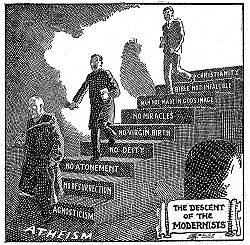
Modern western society is founded upon the products of the Age of Enlightenment and the Scientific Revolution. Values from religious tradition have had an influence on modern society, but science has allowed society to transition to more secular principles and philosophies. Friedrich Nietzsche in his book, The Gay Science, famously said, "God is dead. God remains dead. And we have killed him.", meaning he felt that religious ideals were no longer a credible source of moral judgment. A void was created by secular ideas which allowed man to dethrone it's creator and become the apex of existence. Our modern values are based on this humanist philosophy. Current ethical and philosophical views are dependent on the intrinsic value and agency of human beings.


https://s-media-cache-ak0.pinimg.com/originals/35/cf/9a/35cf9a125205a2d57ce0a9694b65aa87.jpg
https://upload.wikimedia.org/wikipedia/commons/thumb/1/10/Descent_of_the_Modernists,_E._J._Pace,_Christian_Cartoons,_1922.jpg/250px-Descent_of_the_Modernists,_E._J._Pace,_Christian_Cartoons,_1922.jpg 


                                                                                                              https://upload.wikimedia.org/wikipedia/commons/thumb/1/10/Descent_of_the_Modernists,_E._J._Pace,_Christian_Cartoons,_1922.jpg/250px-Descent_of_the_Modernists,_E._J._Pace,_Christian_Cartoons,_1922.jpg
https://s-media-cache-ak0.pinimg.com/originals/35/cf/9a/35cf9a125205a2d57ce0a9694b65aa87.jpg

Post-humanist ideas are in direct conflict with the foundations of modern society because post-humanism rejects the uniqueness and sanctity of humanity. The post-humanist rejects the humanist's claim on man's nature specifically that human's are autonomous, rational and capable of freewill. What would happen if this assumption is proven false, in other words, what would happen if humans are not free agents? Neuroscientist, Sam Harris, makes a strong argument against the existence of freewill, and he himself acknowledges the dangerous implications of such idea. The argument entails a deterministic view of reality where everything from your genetic code to the events in your early childhood influences every decision you make, even those which appear to be free. According to Harris, all decisions are based on processes in the brain and a person's decision could be predicted by analyzing their brain's activity.


If we are all prone to certain behavior patterns based on circumstances completely outside of our control, are we really responsible for our actions? Is a violent criminal responsible for his actions? Are we any different from an animal acting on instinct, or worse, are we any different from a machine running a program? If we are capable of programming machines with intelligence on par with our own, it would imply that our own intelligence functions in a similar way or that our intelligence is not as special as we believe. Without the idea of freewill, concepts like justice and fairness hold no value. Social contracts will not be valid as they are dependent on the free-choice of individuals. The foundations of our society would be ripped out completely.

http://www.troll.me/images/conspiracy-keanu/what-if-im-the-only-human-and-everyone-else-are-just-robots-thumb.jpgPost-humanism's monstrous idea is not of artificial intelligence taking over the world, but the possibility that we are deterministic machines ourselves. Maybe our freewill is an illusion and, in reality, we have no control over our lives. Maybe we are not special, and an intelligence greater than ours is on the horizon. Maybe humanist ideals are no longer a credible source of moral judgment.

"How shall we comfort ourselves, the murderers of all murderers?" — Nietzsche, The Gay Science


http://www.troll.me/images/conspiracy-keanu/
what-if-im-the-only-human-and-everyone-else-are-just-robots-thumb.jpg


Monday, September 12, 2016

This is Not a Blog Post

After reading "Understanding Comics", I started thinking about how people communicate. I find it astonishing that something imagined by a pile of gelatinous bio-matter in your skull can be transferred to another through symbols written on paper. Its also fascinating how we are not limited to one type of medium, but are constantly creating new ways of expressing ourselves. McCloud gives us a view into comics as its own distinct and effective medium of communication. Comics allow ideas to be expressed in ways literature or pictures alone cannot. They provide a dynamic form storytelling that is engaging for the reader. Would the story of the X-Men been equally as influential if it was written in a 800 page novel or would have Batman been as iconic if his debut was on Broadway?

http://cdn4.thr.com/sites/default/files/imagecache/landscape_928x523/2012/09/batman_live_world_arena_tour_a_l.jpg

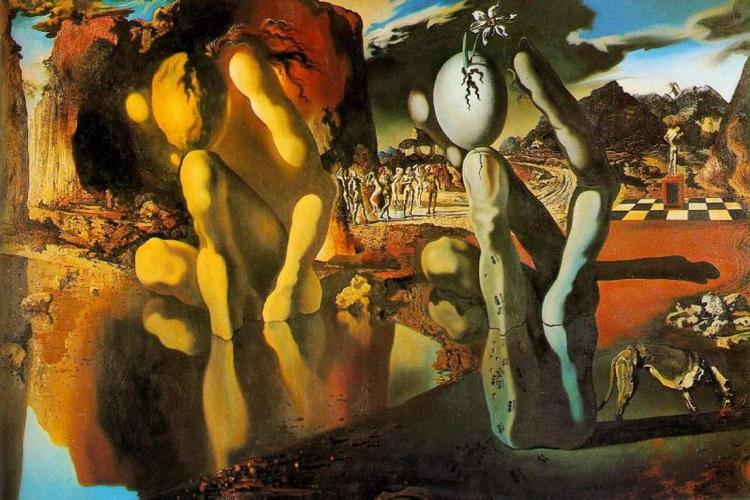
I believe some ideas are better expressed in specific mediums. In order to get your meaning across, you need the audience to focus on certain key features. For example, visual media focuses on your sense of sight while music on your sense of hearing and, as a result, produces a different experience when consumed. The old saying "A picture is worth a thousand words" highlights this idea, though I think the opposite can also be said. Let's experience this first hand by seeing how the medium affects your experience. The following are two different mediums expressing surrealism (Why surrealism? Ceci n'est pas une pipe):

Metamorphosis of Narcissus
By: Salvador Dali

http://all-that-is-interesting.com/wordpress/wp-content/uploads/2012/01/metamorphosis_of_narcissus-Salvador_Dali.jpg

Mobius Strip
By: Robert Desnos
Translated by: Amy Levin

The track I'm running on
Won't be the same when I turn back
It's useless to follow it straight
I'll return to another place
I circle around but the sky changes
Yesterday I was a child
I'm a man now
The world's a strange thing
And the rose among the roses
Doesn't resemble another rose.
 
Both works are trying to communicate their authors ideas of surrealism, each achieving this by taking advantage of their specific medium. Dali captivates his audience through visual juxtaposition giving the audience a sense of wonder in the dream-like world he created. A similar sense of wonder is felt when reading Desnos' poem producing a very similar dream-like feel, but with the ideas being completely expressed in words. Dali used the visual medium, which focuses on visual stimulation, to explicitly create a dream scene for the audience to experience. Desnos on the other hand uses the abstract nature of writing to allow the reader's mind to wander and create the dream scene in their own imagination. Picking the medium of communication is as important as the message being communicated.

I think one of the reasons comics succeed as a medium is due to their ease of consumption. One comic can contain an entire story, be read in about the same time as a short story, and be fully understood on the first reading. Not only that, comics have almost-limitless potential as they have all the benefits of both pictures and writing. If a picture is worth a thousand words, how much is a "juxtaposed pictorial and other images in deliberate sequence"(McCloud 20) worth? Many stories would benefit by being told through comic, but do they lose something when being converted from their source medium? 


Sources:
McCloud, Scott. Understanding Comics:. New York: Harper Perennial, 1994.18. Print.