Showing posts with label comics. Show all posts

Tuesday, December 6, 2016

Try to Coexist?

The main aspects of this comic that really get me going on a rant of questions is simply this…. how could two people doing close to the same thing have so much hate for one another? Everyone has different ways of dealing with life. This is seen between Daredevil and Punisher. No way is certainly right or wrong, but both hate each other for being different from one another.

As I was reading, I thought to myself that their actions against one another, for lack of better words, their actions were stupid. Now, imagine if the two forces teamed up together and fought against crime. I’m not saying that Daredevil and Punisher need to be best friends, they just need to coexist. As Mary writes in a letter to the Punisher, she mentions how the rate of crime has increased significantly since he’s been put into jail. She also mentions lists the forces that stop crimes in the city, which were the police, Daredevil, and the Punisher. With all of these forces being against each other, they are less focused on the defeat of crime but rather in the defeat of one another.


To me, this matter represents a poor allocation of resources around the city. As I said earlier, everyone deals with matters in a different way. I see where the Punisher and Daredevil are coming from, but they both need to learn to coexist. If they were to coexist, crime would decrease and the city would be a safer place. Both of their end goals are the same, to fight crime and to make the city safe. With this said, they are just making their job more difficult than it has to be. 

Picture: http://heroicuniverse.com/the-best-daredevil-vs-punisher-fights/

Monday, December 5, 2016

Can I Get a Back Story??

I think I've officially cracked the code. I've figured out why comics aren't my forte. As most of you probably can guess about me, I don't like being thrown into unknown situations. Sure I can react on my feet and deal with the punches but I prefer to be overly prepared with notes, color-coded binders, a schedule and a time limit. That is ideal for me. But I also recognize that this doesn't happen very often. However....

I absolutely hate it when it happens in books. I hate being thrown into the middle of a story or a plot or a fight scene and I have to work my way backwards, forwards, and sideways to figure out what's going on. You never know a hero/villian's backstory! I'm assuming there are some exceptions to this rule so please tell me them so I can check them out. I want to know if this is what gets me.

I realized this when I was reading the Punisher/Dare Devil comics. Mostly because I wanted to know what happened to the Punisher to make him so evil and twisted. I wanted to know why the heck Dare Devil is a blind ninja man. Was he always blind? Who trained him? WHAT'S HAPPENING?!?

I prefer novels where I create a personal connection with the main character. I like Frankenstein because I was with him as he journeyed thorough his life. I liked Beowulf because I met him at the beginning of his journey. I hated X-men because I get so sick of the classic "you don't know what I've been through" shpeil. Ok, so then tell me what happened to you. Stop being so complex and mysterious, Wolverine, and maybe we can actually get somewhere with this damn story.

I'm really interested in hearing other peoples opinions about this thought because I've started looking at all my favorite books and theres a distinct trend. Mythology is my absolute favorite because you get the story from beginning to end. There's never a point where Zeus is being all pouty because he doesn't want to talk about his past (he's being moody because he inevitably didn't get his way).

I found myself just getting tired of the lack of background I had on the characters.  I just felt like I had a revelation when I said to Punisher (in my head) "Good god man just talk about it and we can all move past this!" But it isn't just with Dare Devil/Punisher. I think many superhero comics are planned this way and I'm sure there is an exact reason for it. I just don't like it. Maybe I'm impatient. Maybe I'm unimaginative. Perhaps I just want some answers. Like I said, this isn't a fool proof theory, there are plenty of exceptions both ways.

Monday, September 19, 2016

Comics: an Acquired Taste

For me, comics are like beer. Maybe with time I'll start to like them but after my first taste, I'm still not loving the flavor.  Maybe its not that I don't like comics but I just haven't tried enough of them to know what I like. But one thing is clear after this reading; I'm not a fan of the Astonishing X-men

I was basically confused from the start as I was only able to identify Cyclops and the blue cat guy (Who's name I discovered later is Dr. McCoy). It was easy to follow the plot and once Wolverine showed up things started to get a little clearer as he’s usually the cause of conflict. But then suddenly they were all giants, standing in the ocean…

I honestly thought I skipped a page and flipped back because I couldn’t understand how they transitioned from the lawn to giant form and an ocean (I’m obviously the person on the hike who’s got the map because if I don’t know where we’re going I get very annoyed). After Dr. McCoy explains that he messed something up with the danger room, I see the humor in it but I felt like it was so abrupt. But I felt like this a lot. It was a constant jump from one scene to the next and it was complicated to follow.

I honestly have no clue what Frost’s powers are. She can read minds but manipulate them but also she turns into diamond (I think I’m confused here…)? She’s fighting Ord and she becomes a diamond. Not sure what happened. Maybe some clarification is needed. Then in the next scene there’s a mini dragon that attacks the bad guy and saves the X-men. It apparently belongs to Kitty but why? I’m not sure. A tiny purple dragon saved the day and well… I thought that was pretty lame. I think if the alien had still kicked all their asses and then simply walked away, there would’ve been an added layer of mystery. The dragon just seemed a little much.

It did get better from there and I started to get more into the story line. Where the heck is the professor? What’s the alien Ord doing with the doctor lady? Who’s the little girl? What’s going on with Jean?!

My issues with this weeks comics stem mostly from randomness that doesn’t really add anything to the plot and over-stimulating pages. Sometimes there was just way too much going happening on a page and every single character had dialogue (a lot of it side comments or snarky remarks). While it does make the conversation seem more genuine, the side comments in combination with the main dialogue in combination with the intense, in your face artwork makes it really hard for me to focus. There’s just too much happening.

Too much happening! 


For instance, what is happening here?                                        
What's that top bit about? What moth? Help. 

I really do wish I liked comics, in a very sincere way. But, like beer, I’m afraid I’m going to have to push through a lot of the ones I don’t like to find the few that suite my taste.

Astonishing Jean?

In the Astonishing X-Men issues one through three, I was shocked to see the leadership of Jean throughout the comic. This makes me wonder if there are subcategories of heroes. I would also argue the same for monsters. For now, I am focusing on the subcategories of heroes and specifically Jean’s standing in the hero category.

In my thoughts I would consider all of the X-Men heroes, but they are all different calibers of heroes. In the comic issues, Jean stuck out to me the most. She was the leader of the heroes and I would consider her the superhero of the group. She does everything in her power to help others, she is almost selfless to a fault. When the X-Men help Nina and the Mannites to protect them from the Death, she is willing to sacrifice herself in order for the Mannites to live long enough to “discover their powers and decide their own fate”.

Along with Jean’s selfless nature, she is the leader of the group throughout the comic issues. When an event arises or action needs to take place all of the characters look to Jean for instruction. For example in the third issue, Nate says “You call the shots, Jean”, Jean acts as the mission leader throughout the quest.

In class we’ve agreed that a superhero acts in a selfless manner and has some type of power that makes them superior to the average hero. As far as powers in the X-Men comics, telekinetic power is definitely the strongest of them all. Jean’s telekinetic energy makes her an obvious choice as a leader.

I feel like Jean’s role in the X-Men movies was underrated immensely. Why would such a central comic characters role be substantially diminished in the movie? Jean serves as the character that overshadows all of the characters to a character in the film that would show up everyone in a while. Does that make sense to anyone else? It sure doesn’t make sense to me!

[Joss Whedon (w) and John Cassaday (a).] Astonishing X-Men, Vol 1. "Gifted" #1-3. (Dec. 2012). [Marvel Comics].

Monday, September 12, 2016

This is Not a Blog Post

After reading "Understanding Comics", I started thinking about how people communicate. I find it astonishing that something imagined by a pile of gelatinous bio-matter in your skull can be transferred to another through symbols written on paper. Its also fascinating how we are not limited to one type of medium, but are constantly creating new ways of expressing ourselves. McCloud gives us a view into comics as its own distinct and effective medium of communication. Comics allow ideas to be expressed in ways literature or pictures alone cannot. They provide a dynamic form storytelling that is engaging for the reader. Would the story of the X-Men been equally as influential if it was written in a 800 page novel or would have Batman been as iconic if his debut was on Broadway?

http://cdn4.thr.com/sites/default/files/imagecache/landscape_928x523/2012/09/batman_live_world_arena_tour_a_l.jpg

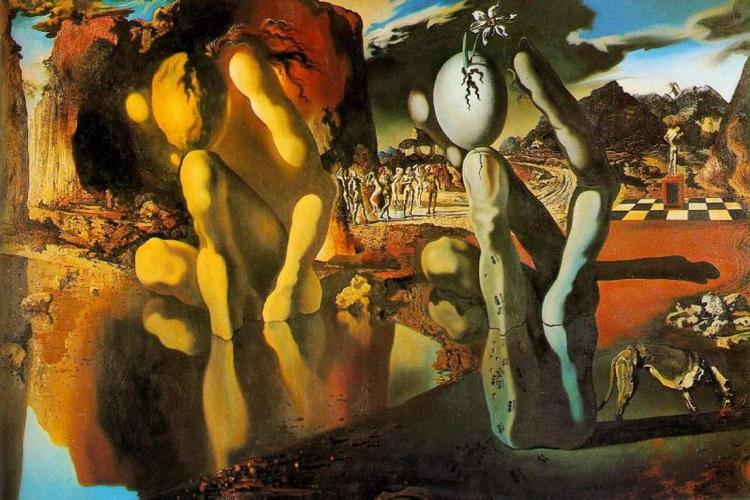
I believe some ideas are better expressed in specific mediums. In order to get your meaning across, you need the audience to focus on certain key features. For example, visual media focuses on your sense of sight while music on your sense of hearing and, as a result, produces a different experience when consumed. The old saying "A picture is worth a thousand words" highlights this idea, though I think the opposite can also be said. Let's experience this first hand by seeing how the medium affects your experience. The following are two different mediums expressing surrealism (Why surrealism? Ceci n'est pas une pipe):

Metamorphosis of Narcissus
By: Salvador Dali

http://all-that-is-interesting.com/wordpress/wp-content/uploads/2012/01/metamorphosis_of_narcissus-Salvador_Dali.jpg

Mobius Strip
By: Robert Desnos
Translated by: Amy Levin

The track I'm running on
Won't be the same when I turn back
It's useless to follow it straight
I'll return to another place
I circle around but the sky changes
Yesterday I was a child
I'm a man now
The world's a strange thing
And the rose among the roses
Doesn't resemble another rose.
 
Both works are trying to communicate their authors ideas of surrealism, each achieving this by taking advantage of their specific medium. Dali captivates his audience through visual juxtaposition giving the audience a sense of wonder in the dream-like world he created. A similar sense of wonder is felt when reading Desnos' poem producing a very similar dream-like feel, but with the ideas being completely expressed in words. Dali used the visual medium, which focuses on visual stimulation, to explicitly create a dream scene for the audience to experience. Desnos on the other hand uses the abstract nature of writing to allow the reader's mind to wander and create the dream scene in their own imagination. Picking the medium of communication is as important as the message being communicated.

I think one of the reasons comics succeed as a medium is due to their ease of consumption. One comic can contain an entire story, be read in about the same time as a short story, and be fully understood on the first reading. Not only that, comics have almost-limitless potential as they have all the benefits of both pictures and writing. If a picture is worth a thousand words, how much is a "juxtaposed pictorial and other images in deliberate sequence"(McCloud 20) worth? Many stories would benefit by being told through comic, but do they lose something when being converted from their source medium? 


Sources:
McCloud, Scott. Understanding Comics:. New York: Harper Perennial, 1994.18. Print.


Saturday, September 10, 2016

The Second-Class Status of Comics

Having read the first two chapters of Understanding Comics by Scott McCloud, one particular passage from the first chapter stuck out to me. "For much of this century," Scott writes, "the word 'comics' has had such a negative connotation that many of comics' most devoted practitioners have preferred to be known as 'illustrators,' 'commercial artists,' or, at best, 'cartoonists'!" (McCloud 18). It was a sad reminder that, no matter how deep or thoughtful a comic can be, it will always be seen as juvenile by society overall.

Two comics immediately came to mind when I finished that page - Will Eisner's The Plot, and Art Spiegelman's Maus. I read both comics in high school, during a time when I voraciously read through much of Archbishop Spalding's fiction library. Though I had to read Maus for my sophomore English class, I read The Plot on my own time. Nevertheless, I was captivated by the combination of art and prose in both comics.


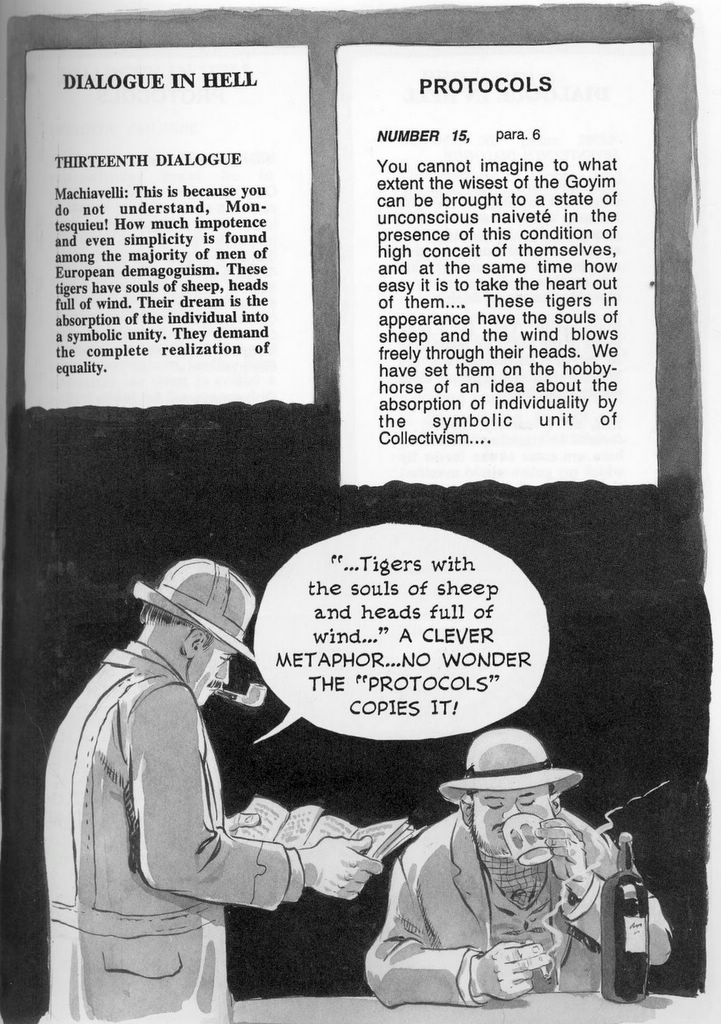
The Plot, a detailed account of the fabrication of the Protocols of the Elders of Zion, had a unique art style that combined detailed character designs with exaggerated expressions. It told a story that spanned centuries and involved disgruntled French authors and conniving Tsarist advisers desperate to hold onto power. It was a well-researched and tragic tale that kept my interest throughout its length. Why, then, is it never brought up in any way, shape, or form when high-quality non-fiction is discussed? Is it the "cartoonish" artwork that prevents critics from taking its contents seriously, no matter how thought-provoking it may be? Or did its black sheep status as a non-fiction comic keep it in obscurity? 

Of course, it is entirely possible to break free from the "ghetto" that most comics reside in, and establish a comic as serious reading material. Maus fits this idea to the T.

I remember my surprise at Maus being taught like the other books in my curriculum. While its subject matter was serious, it looked like any other comic sidelined for not fitting the standards of a "serious book." I enjoyed both volumes of Maus, as tragic as its depiction of the Holocaust was, but a question irked me throughout my reading of it: why this, and not The Plot? Both dealt with anti-antisemitism, historical events, and the depths of human depravity when dealing with "outcast" groups. Didn't both deserve credit for taking serious risks and presenting their material in an unorthodox, easier-to-consume format?

I do not think there is an easy answer to those questions. Sometimes, it might boil down to sheer, dumb luck. Critics in all fields are known for their bizarre tastes - the much-hated and generally-unfunny Ghostbusters reboot currently holds a higher Rotten Tomatoes rating than the moody, thought-provoking "Only God Forgives" and a near-equal rating with the uncompromising "Falling Down." Some practical elements may have factored into this discrepancy: Maus was published nearly three decades ago and had a stagnated release, while The Plot is only 11 years old. 

"What are you driving at, exactly?" You might ask. Well, it all comes down to this - like what McCloud said, anyone defending comics has the deck heavily stacked against them. Though the old-fashioned view of comics being for nerds and children no longer holds water today, it lingers in the backs of society's attitudes. We scoff at comics as being below us, yet we cannot put our fingers on why most people hold that view. 

Granted, for every Batman: The Long Halloween and Watchmen, there are dozens of disposable comics churned out by Marvel, DC, and other companies. But we should never allow our view of a medium to be tainted by its worst examples. Should all of literature be tossed aside because of Twilight and 50 Shades of Grey? Of course not, so why should comics be viewed as an inferior medium due to the existence of garbage like Nightcat?

Comics are undeserving of the second-class status society has lumped upon them. They deserve to be treated like any other piece of literature, not as a minor amusement.

Sources:

Eisner, Will, and Umberto Eco. The Plot: The Secret Story of the Protocols of the Elders of Zion. New York: W.W. Norton, 2005. Print.

McCloud, Scott. Understanding Comics:. New York: HarperPerennial, 1994. 18. Print.

Spiegelman, Art. Maus: A Survivor's Tale. Vol. 2. New York: Pantheon, 1986. Print.