Showing posts with label posthumanism. Show all posts

Monday, September 26, 2016

Humanity is dead. And we have killed them.

Post-humanism offers an interesting, though frightening, perspective on humanity. Post-humanist concepts are often associated with science, technology, and the future of the human race.  The rate of technological advancement is accelerating, and the increasing symbiosis between human and machine has led many to speculate on the effects of such relationship. Artificially intelligent systems, like IBM's Watson and Google's Alpha Go, have sparked our interest of the mythical "Singularity" event while whistle-blowers, like Edward Snowden, remind us that "Big-Brother" is already watching. It seems rational to fear the capabilities of technology. One day technology may offer us a cure to cancer and the next day it may offer us weapons of mass destruction. Though it seems that post-humanism focuses on technology and its effects on humanity, I believe post-humanism describes a darker existential implication that is in direct conflict with societies' modern values and ideals.
http://watson2016.com/_images/watson_on_jeopardy.jpg


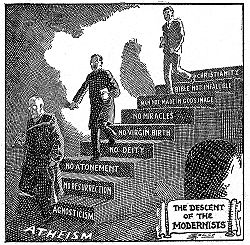
Modern western society is founded upon the products of the Age of Enlightenment and the Scientific Revolution. Values from religious tradition have had an influence on modern society, but science has allowed society to transition to more secular principles and philosophies. Friedrich Nietzsche in his book, The Gay Science, famously said, "God is dead. God remains dead. And we have killed him.", meaning he felt that religious ideals were no longer a credible source of moral judgment. A void was created by secular ideas which allowed man to dethrone it's creator and become the apex of existence. Our modern values are based on this humanist philosophy. Current ethical and philosophical views are dependent on the intrinsic value and agency of human beings.

https://s-media-cache-ak0.pinimg.com/originals/35/cf/9a/35cf9a125205a2d57ce0a9694b65aa87.jpg
https://upload.wikimedia.org/wikipedia/commons/thumb/1/10/Descent_of_the_Modernists,_E._J._Pace,_Christian_Cartoons,_1922.jpg/250px-Descent_of_the_Modernists,_E._J._Pace,_Christian_Cartoons,_1922.jpg 


                                                                                                              https://upload.wikimedia.org/wikipedia/commons/thumb/1/10/Descent_of_the_Modernists,_E._J._Pace,_Christian_Cartoons,_1922.jpg/250px-Descent_of_the_Modernists,_E._J._Pace,_Christian_Cartoons,_1922.jpg
https://s-media-cache-ak0.pinimg.com/originals/35/cf/9a/35cf9a125205a2d57ce0a9694b65aa87.jpg

Post-humanist ideas are in direct conflict with the foundations of modern society because post-humanism rejects the uniqueness and sanctity of humanity. The post-humanist rejects the humanist's claim on man's nature specifically that human's are autonomous, rational and capable of freewill. What would happen if this assumption is proven false, in other words, what would happen if humans are not free agents? Neuroscientist, Sam Harris, makes a strong argument against the existence of freewill, and he himself acknowledges the dangerous implications of such idea. The argument entails a deterministic view of reality where everything from your genetic code to the events in your early childhood influences every decision you make, even those which appear to be free. According to Harris, all decisions are based on processes in the brain and a person's decision could be predicted by analyzing their brain's activity.


If we are all prone to certain behavior patterns based on circumstances completely outside of our control, are we really responsible for our actions? Is a violent criminal responsible for his actions? Are we any different from an animal acting on instinct, or worse, are we any different from a machine running a program? If we are capable of programming machines with intelligence on par with our own, it would imply that our own intelligence functions in a similar way or that our intelligence is not as special as we believe. Without the idea of freewill, concepts like justice and fairness hold no value. Social contracts will not be valid as they are dependent on the free-choice of individuals. The foundations of our society would be ripped out completely.

http://www.troll.me/images/conspiracy-keanu/what-if-im-the-only-human-and-everyone-else-are-just-robots-thumb.jpgPost-humanism's monstrous idea is not of artificial intelligence taking over the world, but the possibility that we are deterministic machines ourselves. Maybe our freewill is an illusion and, in reality, we have no control over our lives. Maybe we are not special, and an intelligence greater than ours is on the horizon. Maybe humanist ideals are no longer a credible source of moral judgment.

"How shall we comfort ourselves, the murderers of all murderers?" — Nietzsche, The Gay Science


http://www.troll.me/images/conspiracy-keanu/
what-if-im-the-only-human-and-everyone-else-are-just-robots-thumb.jpg


Friday, September 23, 2016

Deus Ex and Posthumanism

When I see the word "Posthumanism," the first thing that comes to my mind is the "Deus Ex" videogame series. This is with good reason, of course - the games, particularly the original and its prequel, center their stories around the development of wide-reaching artificial intelligence, human augmentation, and struggles between ordinary humans and their augmented counterparts.


Deus Ex, released in 2000; and Deus Ex: Human Revolution, released in 2011, are first-person role playing games published by Eidos and Square Enix respectively. Both are well-known for their intricate plots that tie current events with potential future issues and conspiracy theories. The appreciation for the games is so strong that it gamers often joke about reinstalling them if they are ever brought up.

Though the two games I am focusing on are divided by age both in the story and real life, they both cover posthuman topics through thought-provoking conversations and dialogue.

Human Revolution takes place in 2027, during the "Golden Age of Human Augmentation." Millions of people across the globe have installed mechanical limbs and other improvements onto themselves, improving countless lives while also creating resentment among non-augmented individuals.


Adam Jensen, the player character, is a security officer who was narrowly saved via extensive augmentation after a terrorist attack destroyed his workplace. Though this gave him powerful abilities, he had no say in his fate, leaving him in a self-loathing state for part of the story.

The game indirectly asks what it means to be human. Some characters, like the Purity First militants, insist that augmentation soils the basic idea of human growth and development. Others, like Sarif Industries' CEO, consider augmentation to be the next step in human evolution, and work to make it accessible to as many people as possible.

Notably, no answers are given to the player for this question. Instead, it leaves you to decide for yourself. Adam has retractable blades in his arms, sunglasses built onto his face, and can punch through walls without any serious issues. His abilities may exceed that of a normal human, but is he still human? Or has he become something greater than human, something humanity should strive to become?


The original game in the series, Deus Ex, examines another philosophical question (among many others): what does it mean to be a non-human? Can they ever be considered on-par with humanity, or are they somewhere below or above us?

Taking place in 2052, Deus Ex tells the story of J.C. Denton, a UN Peacekeeper assigned to quell a terrorist movement in the United States. What follows is a mind-boggling plot about governmental overreach and humanity's tendency to worship beings "above" them, even if their origins lie with humankind.

The game's final choices hinge on deciding humanity's future and who should lead it. Should it be left in the hands of centuries-old secret societies? Or should an absolute dictator, in the form of a benevolent AI program, guide it along? Perhaps a third option, where all hints of the old order are wiped away and mankind is forced to fend for itself?


Morpheus, a prototype for a more advanced computer, is at one point questioned by JC for its surveillance of humanity. It may be Orwellian to watch over as many people as it does, but is it not ultimately giving people what they want? We crave attention, as demonstrated by how much personal information we put on social media for people to like and comment on.

Something I noticed while writing this was the conscious effort I had to make to dehumanize Morpheus. After watching the video for a second time, I unconsciously described the AI as a "he," but deleted that and put "it" instead.

Is there anything non-physical that separates Morpheus from JC, though? They both think and react to their environments. They both provide insights on events and have greater ambitions to pursue. It even has a masculine voice and projected appearance. If it were considered a living being, would its immobile state rank it below humanity, or would its all-seeing network make it humankind's superior?

It has been a while since I played both games, but I still do not have answers for its questions. Perhaps that was the intention of their creators - to have players dwell on its topics long after completion. If so, they have succeeded. Whenever posthumanism is discussed, I always think back to Deus Ex and Deus Ex: Human Revolution.

Works Cited:

Eidos Interactive. Deus Ex. Ion Storm, 2000. PC.

Square Enix. Deus Ex: Human Revolution. Eidos Montreal, 2011. PC.