Showing posts with label Understanding Comics. Show all posts

Monday, September 12, 2016

This is Not a Blog Post

After reading "Understanding Comics", I started thinking about how people communicate. I find it astonishing that something imagined by a pile of gelatinous bio-matter in your skull can be transferred to another through symbols written on paper. Its also fascinating how we are not limited to one type of medium, but are constantly creating new ways of expressing ourselves. McCloud gives us a view into comics as its own distinct and effective medium of communication. Comics allow ideas to be expressed in ways literature or pictures alone cannot. They provide a dynamic form storytelling that is engaging for the reader. Would the story of the X-Men been equally as influential if it was written in a 800 page novel or would have Batman been as iconic if his debut was on Broadway?

http://cdn4.thr.com/sites/default/files/imagecache/landscape_928x523/2012/09/batman_live_world_arena_tour_a_l.jpg

I believe some ideas are better expressed in specific mediums. In order to get your meaning across, you need the audience to focus on certain key features. For example, visual media focuses on your sense of sight while music on your sense of hearing and, as a result, produces a different experience when consumed. The old saying "A picture is worth a thousand words" highlights this idea, though I think the opposite can also be said. Let's experience this first hand by seeing how the medium affects your experience. The following are two different mediums expressing surrealism (Why surrealism? Ceci n'est pas une pipe):

Metamorphosis of Narcissus
By: Salvador Dali
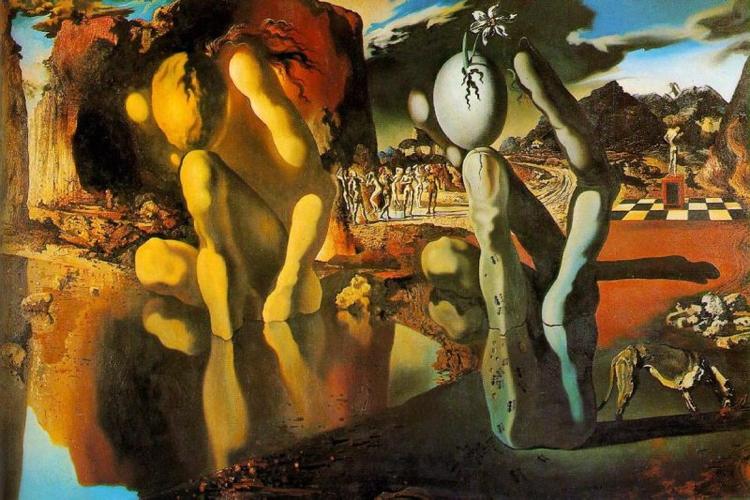
http://all-that-is-interesting.com/wordpress/wp-content/uploads/2012/01/metamorphosis_of_narcissus-Salvador_Dali.jpg

Mobius Strip
By: Robert Desnos
Translated by: Amy Levin

The track I'm running on
Won't be the same when I turn back
It's useless to follow it straight
I'll return to another place
I circle around but the sky changes
Yesterday I was a child
I'm a man now
The world's a strange thing
And the rose among the roses
Doesn't resemble another rose.
 
Both works are trying to communicate their authors ideas of surrealism, each achieving this by taking advantage of their specific medium. Dali captivates his audience through visual juxtaposition giving the audience a sense of wonder in the dream-like world he created. A similar sense of wonder is felt when reading Desnos' poem producing a very similar dream-like feel, but with the ideas being completely expressed in words. Dali used the visual medium, which focuses on visual stimulation, to explicitly create a dream scene for the audience to experience. Desnos on the other hand uses the abstract nature of writing to allow the reader's mind to wander and create the dream scene in their own imagination. Picking the medium of communication is as important as the message being communicated.

I think one of the reasons comics succeed as a medium is due to their ease of consumption. One comic can contain an entire story, be read in about the same time as a short story, and be fully understood on the first reading. Not only that, comics have almost-limitless potential as they have all the benefits of both pictures and writing. If a picture is worth a thousand words, how much is a "juxtaposed pictorial and other images in deliberate sequence"(McCloud 20) worth? Many stories would benefit by being told through comic, but do they lose something when being converted from their source medium? 


Sources:
McCloud, Scott. Understanding Comics:. New York: Harper Perennial, 1994.18. Print.


Comics, Space, and Star Wars

When Scott McCloud began to set the record straight in Chapter 1, he brought up one specific point that I thought was particularly interesting. Here's the quote - or dialogue, I guess: 

"Taken individually, the pictures below [not pictured] are merely that - pictures. However, when part of a sequence, even a sequence of only two, the art of the image is transformed into something more..." (pg. 5) 

Central to the idea of the comic is the concept of sequence. There is an order to pictures/words/images/events/etc that gives them meaning. The narrative of a particular text is meaningful because of the sequences that interact (plot, characterization, the various nuts and bolts of a story) inside of it. It's progressive - image A leads to image B leads to image C (for example), and so on and so forth. Long story short: a sequence makes a narrative. 

It doesn't even have to be a linear narrative - the sequence that makes up a non-linear narrative is still a linear sequence, because time is still just one of the thing that make up a text. Star Wars is actually a great example of this: narratively, it opens in media res, but A New Hope is the first movie sequentially - even though it is fourth in the timeline. 


star wars
(messing with your preconceived notions about narrative and timelines since 1977)

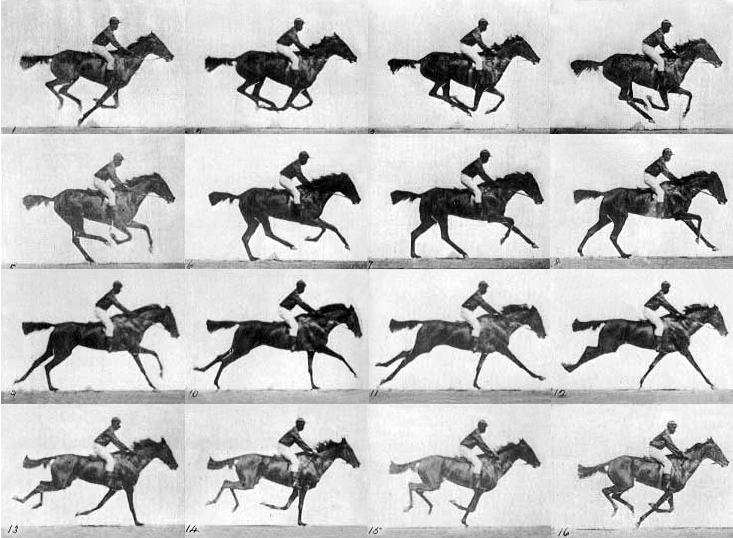
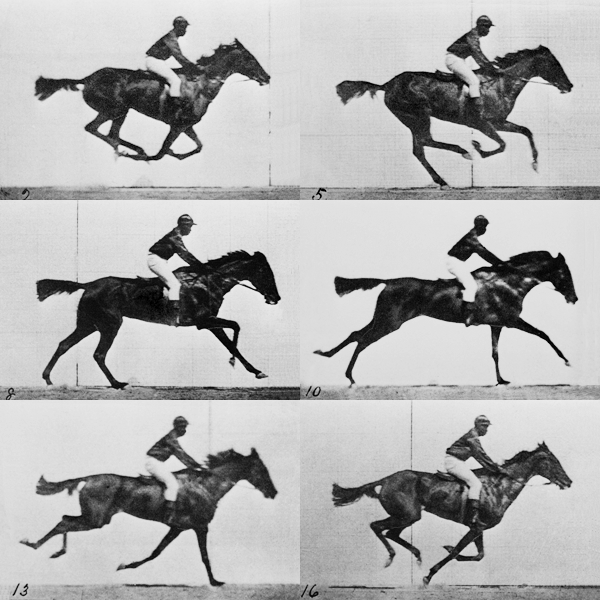
McCloud brings up the idea that "space does for comics what time does for film" (pg. 7) Comics are spatially sequenced; the space between them is the sequence. Comic action happens in the blank lines between each frame. To help myself visualize this, I remembered my junior year of high school, when I had to learn about early photography in either Photo 2 or AP Art History. Here are the frames of Eadweard Muybridge's work with horse racing: 


Eadweard Muybridge, Human and Animal Locomotion series, 1887

Now here's the same thing, only animated: 

(same citation, but accessed on Wikipedia) 

There's still a gap from point A to point B. If you look at the sheet (if you want to call it a storyboard, I guess you could - I'm pretty sure there's a term for all those frames lined up, but I can't remember what it is) you see that there's missing action - we don't see the horse's leg go from straight to bent. That's action we missed, that we didn't see. The meaning is not only in points A and B, but how we get there, the space that makes them different.

(A random aside: I was thinking about how so many comics are adapted to film, and I began to wonder if filmmakers in general don't like to read comics because comics are so reminiscent of storyboards - maybe almost like comics are unfinished, unrefined bits of a larger work? Or maybe they like to read them for much the same reason? I'm not sure. Who knows?)

Sources: 
McCloud, Scott. Understanding Comics:. New York: Harper Perennial. 1994.18. Print. 

Sunday, September 11, 2016

Ack! Comics!

Let me start off by saying that except for reading a few Cathy comic strips found in newspapers when I was much younger, I am completely new to the world of comics.

http://msmagazine.com/blog/2010/08/12/cathy-to-utter-her-last-ack/

Reading McCloud’s Understanding Comics was an overwhelming experience.  I had never realized the complexity of comics or the amount of thought and work put into them. It is a lot to process and I found myself getting lost in his chapter of icons.  Did you know that there are different degrees of realism in simply drawing a face and that each degree of realism conveys a different connection and understanding to the material???  Neither did I!!!  Confusing right?!

Once I got through the initial barrage of pictures and words, the nuances of the art of comics started to become clear.  I was impressed by the amount of thought and detail that go into each page.  As explained in chapter three, the size of the box, the space or “gutter” between the boxes, and the shape of the boxes are all deliberate in conveying the artist’s message.  Who knew it was that complex?!  I merely thought boxes were used to separate each image so the reader wouldn't get confused.  I was also impressed by the mood that can be invoked with simple lines.  It is easy to convey emotions with words and you often get distracted by them, but to look closer at the drawings and feel the anger, sadness, or love coming from the artist is impressive.

I am a frequent watcher of the show The Big Bang Theory and for those unfamiliar with the show, most of the main characters are religious in their love of comic books.  A love that I had never fully understood.  However, I am beginning to understand why comics are so popular.  They are not merely images in little boxes with onomatopoeia splattered across.  Each stroke of the pen is deliberate. The degree of realism in the character versus the background is purposeful.  Whether a line is straight, curved, bold, or broken all have meaning in relation to the story and mood the artist is creating.  I don’t think I will look at comics the same.  I imagine there are varying degrees of comics and art within them but I am quite impressed with the field overall.  They truly are works of art.  Kudos to all the comic artists out there!

http://www.imdb.com/title/tt0898266/mediaviewer/rm3293874432


Additional Source:
McCloud, Scott. Understanding Comics:. New York: Harper Perennial, 1994.18. Print.
Overwhelmed by Comics

Before reading the first five chapters of “Understanding Comics,” the only comics I had ever really read were those in the newspaper. Whenever my grandfather would get the newspaper I would sit down next to him at the breakfast table and read the comic section. I used to love all of the funny pictures and cartoon animals.

Now as I’m sitting down reading this comic book, I don’t feel the immediate joy that I did as a kid. Instead, I honestly find comic books rather overwhelming and dizzying. There are so many different pictures and words that my eyes can’t find one thing to focus on. I like to consider myself a fairly organized person and I tend to make a lot of “to-do lists.” Sometimes, before I make those lists, I get super overwhelmed with all of the thoughts jumbled around in my head. When I look at this comic book I get that same feeling, as if I’m looking at the inside of my brain.

While I’m overwhelmed, I’m doing my best to be open to reading a new style of writing I’m not used to, but there’s a few things that are REALLY bothering me…

1. Why are there some words that are randomly BIGGER or BOLDER than all of the other words? You usually see this done to draw the reader’s attention to certain words, but just like over highlighting a text, can’t you overemphasize too many words?

2. Why is there so much gosh darn writing and art work on one page? I will admit that it is pretty cool that there are so many different types of artwork and fonts (you name it)! But, there is just so much on one page that I can’t really process it all.

3. Okay, so good ‘ole Scott McCloud says you read a comic left to right, just like a book, but some of the boxes are different sizes and shapes that it seems more like left, down, right, down, left, up to the right, etc.

So, I guess you can gather that reading this comic book and learning how to read comics/history about comics is not my favorite thing, but I will say there was one thing I appreciated.


At the beginning of the second chapter McCloud talks about the vocabulary of comics. For those of you who don’t like sappy love movies, the first two pages of this chapter are talked about in the movie “The Fault in Our Stars,” when Hazel Grace where’s a shirt that says, “This is not a pipe,” under a picture of a pipe. Though I love that movie and appreciated the common connection, I was mainly intrigued for the very same reason I was dissuaded by comics-they’re super complex and detailed. While it still confuses me, there are so many different possibilities that exist within comics and it just fascinates me how incredible our imaginations are! Kudos to all the people who can actually sit down and draw and write like this, I know I can’t.